

Getting a kayak from your garage to the water shouldn’t be the hardest part of the day. Whether you paddle every weekend or dust off the boat a few times a summer, the right roof setup saves your back, your paint job, and your patience. This guide walks through eight solid options, from folding steel carriers to soft pad kits that work on cars without crossbars at all.
An Overview Of The Picks

Malone Downloader Folding J-Style Kayak Carrier

Taelakeni 2 Pairs Kayak Carrier Racks (4 Racks)

Abahub Soft Roof Rack Pads for Kayak and Surfboard
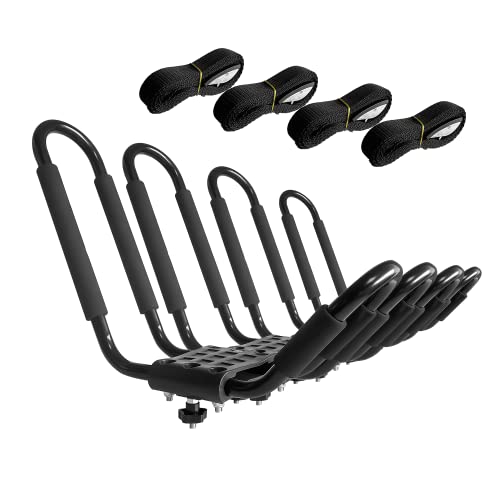
HIGHRAZON 2 Pair J-Bar Roof Rack with 4 Ropes

Yima Accessories 2 Pairs Kayak Roof Rack Carrier

SELERETE Universal Soft Kayak Roof Rack Pads Kit

HIGHRAZON 1 Pair J-Bar Roof Rack with 2 Ropes

FORWODE Premium 2 Pair Folding J-Bar Roof Rack
The Picks, Examined More Closely
The Malone Downloader earns its reputation through details most budget racks skip. A built-in boarding ramp gives you a surface to lean the hull against while you lift, which matters more than any spec sheet line when you’re loading solo in a parking lot. The folding mechanism drops the carrier flat against the bar, restoring overhead clearance for garages and parking structures.
Its JAWZ mounting hardware grips round, square, and most factory oval crossbars, so compatibility headaches largely disappear. Oversized padding cushions the hull on highway runs. Compared with the budget J-bars further down this list, this is the option built for years of frequent use.
A Few Strong Suits
- Built-in boarding ramp makes solo loading far easier on your back
- Folds down to reclaim garage and drive-through clearance
- JAWZ clamps fit round, square, and most factory oval bars
- Oversized padding protects gelcoat during long hauls
- Bow and stern lines included for proper four-point securing
Things To Consider
- You pay a premium over basic fixed J-bars, which stings if you paddle only a few times a year
- Owners commonly report checking clamp torque periodically, since vibration can loosen hardware over time
Key Specs
Who It Suits Best
Weekend paddlers who load alone and want a carrier they can leave mounted all season.
Where Another Pick Suits Better
Occasional users hauling two boats on a tight budget will get more from the Taelakeni four-rack set.
Where the Malone focuses on refinement, the Taelakeni set goes for coverage: four J-bar carriers in one package, rated at 150 pounds combined. That’s enough for two kayaks side by side, or a single boat with room to spare for skis or snowboards come winter.
The steel construction carries a baked-on finish that resists rust, a real consideration for gear that lives outside through salty coastal air. One honest limitation: these mount to flat and square crossbars only, not round ones, so check your roof rack profile before ordering. The wide-mouth J shape keeps loading straightforward and leaves most of the bar free for other cargo.
A Strong Showing
- 150-pound capacity handles two kayaks or mixed gear
- Baked finish on steel holds up against corrosion season after season
- Wide-mouth J-bars make hull positioning forgiving
- Sideways carrying orientation uses minimal bar space
Worth Noting
- Incompatible with round crossbars, a dealbreaker for some factory racks
- Tie-down straps are not part of the package, so budget for those separately
- Regularly re-tighten all fasteners before driving, as the manufacturer stresses
Made For
Households running two boats or swapping between seasonal gear on square or flat crossbars.
A Better Fit Elsewhere
Drivers with round factory bars should look at the Abahub soft pad kit instead, which sidesteps crossbar shape entirely.
No crossbars? That’s the problem this Abahub kit solves. Soft pads strap directly to your roof, working on sedans, hatchbacks, SUVs, and two- or four-door cars with or without side rails. For anyone renting cars on trips or driving a vehicle that never got a rack installed, it’s the difference between paddling and staying home.
Setup takes minutes rather than an afternoon of bracket alignment, and the whole system packs into a trunk when not in use. The trade-off is speed discipline: soft systems demand careful strapping and moderate highway pace, unlike the locked-in feel of a steel J-bar. In our view, that’s a fair exchange for the flexibility.
Everyday Advantages
- Fits vehicles with or without side rails, no crossbar purchase needed
- Handles kayaks, SUPs, surfboards, canoes, and snowboards alike
- Stores compactly in a trunk between outings
- Gentle on car paint compared with bare metal contact
Minor Gripes
- Soft pads shift more than hard racks on rough roads, so stop-and-check habits matter
- Not the choice for sustained interstate speeds with a heavy tandem boat
At A Glance
Right Fit For
Travelers and city drivers whose vehicles lack crossbars but still want regular water access.
Consider Something Else When
Long highway hauls with a heavy boat favor the FORWODE folding steel rack instead.
This is the two-boat version of the HIGHRAZON design, angled at roughly 45 degrees so the hull nestles into the J-frame instead of balancing on top of it. Four tie-down ropes ship in the box, covering both boats without a separate shopping trip. For families shuttling a pair of rec kayaks to the lake, that completeness counts for a lot.
The angled cradle also means less wind resistance than deck-mounted setups, something you notice on long drives. Anything that tucks into the J-frame works here, including canoes and even sailboards, which adds flexibility beyond pure kayak duty.
Bright Spots
- 45-degree J-angle locks the hull into the frame securely
- Four ropes included means two fully rigged boats out of the box
- Accommodates kayaks, canoes, and sailboards within the frame
- Suits SUVs and trucks with standard crossbars
Points To Note
- Fixed design stays upright year-round, eating clearance in low garages
- Rope tie-downs demand proper knot knowledge; cam straps are quicker for beginners
Quick Facts
Who Will Love This
Families or friend groups regularly moving two recreational kayaks on SUV or truck crossbars.
Look Elsewhere When
Solo paddlers carrying one boat will find the single-pair HIGHRAZON set below covers them at lower cost.
Sometimes the cheapest path to the water is the right one. The Yima set is a plain, functional two-pair J-bar package aimed squarely at first-time buyers who don’t want to overthink hardware. There’s no folding mechanism, no premium padding, just a straightforward carrier that holds a boat on its side.
The kit includes 1-inch-wide, 10-foot straps with buckles designed to hold tension over repeated trips, and the mounting screws use a thread-locking approach to resist loosening on bumpy roads. You may find the finish less refined than pricier options here, and that’s the honest trade-off: this is entry-level gear that does its job without extras.
The Practical Payoff
- Low-cost way to start hauling a kayak without a big commitment
- Thread-locking screws help hardware stay put on rough roads
- 10-foot straps give enough length for most hull-and-roof combinations
Softer Spots
- Basic build quality shows next to the Malone’s padded, folding design
- Strap buckles deserve a pre-trip inspection as they age
- Two pairs may be overkill if you only ever carry one boat
Who Should Grab It
First-time kayak owners testing whether roof transport fits their routine before investing more.
Reach For A Different Pick When
Anyone planning weekly use will appreciate the FORWODE rack’s thicker frame and folding convenience.
The SELERETE kit competes directly with the Abahub pads above, and its edge is completeness. Alongside the pads themselves, you get 20-foot tie-down straps, two lengths of rope, and four quick-loop straps, which is genuinely everything needed to rig a boat on day one. No second order, no improvising with rope from the garage.
The pads use UV-resistant 900-denier nylon over EVA foam, a material combo that shrugs off sun exposure and resists flattening under load. An antiskid layer underneath keeps the pads from wandering on the roof while you cinch everything down.
Positive Takeaways
- Full kit: pads, 20-foot straps, rope, and quick loops included
- 900-denier nylon shell withstands UV exposure over seasons
- EVA foam fill resists heat deformation under heavy hulls
- Antiskid base prevents pad movement during tightening
Small Caveats
- Same soft-rack limits as any pad system: careful strapping and sensible speeds required
- Quick-loop straps need checking for wear where they pass through door frames
Core Details
Whose Shelf It Belongs On
Paddlers splitting time between kayaks and SUPs who want one grab-and-go kit for any vehicle.
Skip It When
Permanent daily commuting with a boat points toward the Malone folding carrier’s locked-down security.
Single boat, single pair, same proven geometry as the four-carrier HIGHRAZON earlier in this list. The roughly 45-degree J-frame cradles the hull on its side, and two ropes handle bow, stern, and mid-hull securing for one kayak. Nothing here tries to be clever, and for solo paddlers that’s exactly the point.
Because only two carriers occupy the crossbar, you keep free bar space for cargo boxes, bike trays, or lumber runs. The J-frame accepts anything that fits inside it, so a canoe or sailboard remains fair game too.
What Stands Out
- Right-sized for one boat without paying for unused carriers
- 45-degree cradle holds the hull firmly in place
- Leaves crossbar room free for other roof accessories
Room For Improvement
- Only two ropes included, so longer boats may need extra tie-down points
- Fixed upright posture requires garage clearance awareness
The Right Fit
Solo recreational kayakers with one boat and modest storage needs on a car or small SUV.
Another Choice May Suit
Two-boat households should step up to the HIGHRAZON 2 Pair version reviewed above for matched capacity.
The FORWODE brings near-premium engineering to the value segment. Its carbon steel frame uses a thickened 1.2mm tube wall on 25mm tubing, a combination that stays light yet supports up to 160 pounds across two boats. Heavier tandem kayaks that would strain thinner budget bars sit comfortably here.
The fold-flat handle adjusts the carrier down when not in use, echoing the Malone’s clearance trick at a friendlier cost. Rust and corrosion treatment means you can reasonably leave it mounted through a season of weather. Among the steel J-bars in this guide, this is the one built for demanding, frequent hauling.
Reasons It Performs
- 160-pound capacity suits heavy tandem and fishing kayaks
- Thickened 1.2mm walls on 25mm tubing balance strength with weight
- Fold-flat handle restores overhead clearance quickly
- Corrosion-resistant finish tolerates being left mounted outdoors
- Carries two boats on SUV, car, and truck crossbars
Details To Watch
- Heavier overall than minimalist single-pair racks, so installation is a two-person job for some
- Owners commonly report periodic bolt checks keep everything quiet on washboard roads
Feature Snapshot
Best Suited To
Anglers and tandem paddlers hauling heavy boats several times a month on truck or SUV crossbars.
Not Your Match When
Lightweight occasional use costs less with the Yima two-pair set, assuming modest hull weights.
Factors To Weigh Before Choosing Kayak Car Racks
Match the Rack to Your Crossbars
Hard J-bar carriers need compatible crossbars, and bar shape decides everything. Square and flat bars accept most clamp designs, round factory bars often reject them, and oval bars land somewhere in between. Measure your bar profile before clicking buy; it’s the single most common mismatch in this category.
Know Your Vehicle Situation
No crossbars at all? Soft pad kits like the Abahub and SELERETE options strap directly to the roof and solve the problem entirely. They suit sedans, rentals, and occasional trips, though they reward careful strapping and moderate speeds more than rigid steel does.
Count Your Boats Honestly
A single-pair rack costs less and frees bar space. Two-pair sets make sense only when two boats actually travel together. Overbuying capacity adds weight, wind noise, and garage-clearance problems for no benefit.
Factor Loading Height and Frequency
Weekly paddlers benefit from folding mechanisms and boarding ramps that reduce daily friction. Twice-a-season users can happily live with fixed budget bars and save the difference for a good paddle.
Key Considerations Across These Picks
Traps First Timers Fall Into
The classic mistake is buying a hard rack for round factory crossbars, then discovering the clamps won’t close. The second is skipping tie-downs: a hull must be secured front, rear, and sides regardless of how snug the carrier feels. Re-checking fasteners after the first few drives prevents most wobble complaints.
What Separates Premium From Basic
Higher-tier racks spend money on thicker steel, corrosion coatings, padding width, and folding hinges. Those features pay off for frequent users and heavy boats. Paddle three times a year, and a basic fixed J-bar delivers nearly the same outcome for far less.
Closing Remarks
Every pick here solves the same core problem: getting a boat onto your roof safely without dreading the drive. Match the carrier to your crossbars, count your boats honestly, and be realistic about how often you’ll load it. Do those three things and any option on this list will serve you well, season after season on the water.
