

Getting a kayak to the water shouldn’t feel like a puzzle. The right roof rack turns a two-person wrestling match into a five-minute job you can do solo before work. This roundup covers eight solid options across hard J-bar carriers and soft pad systems, so whether your car has crossbars or just bare rails, there’s something here that fits.
A Fast Comparison Of The Options

Taelakeni Universal Kayak Roof Rack (4 Racks)

FDB J-Bar Kayak Canoe Carrier with Tie Down Straps

Abahub Soft Kayak Roof Rack Pads
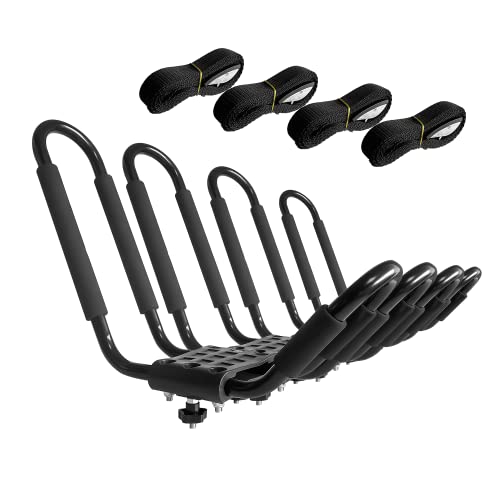
HIGHRAZON 2 Pair J-Bar Kayak Roof Rack with Ropes

SELERETE Soft Kayak Roof Rack Pads with Straps

HIGHRAZON 1 Pair J-Bar Kayak Roof Rack with Ropes

FORWODE Folding Adjustable Kayak Roof Rack (2 Pairs)

BougeRV Crab Kayak Saddle Roof Rack Kit
Taking A Closer Look At The Options
Four racks in one box means this set carries two boats side by side, or one kayak plus a snowboard when winter rolls around. The wide-mouth J-shape holds the hull on its edge, which leaves most of the crossbar free for other gear.
The steel frame carries up to 150 lbs and mounts to nearly any flat or square bar on the market. That flexibility matters if you share cars within a family or upgrade vehicles often.
The Case For It
- 150 lb capacity handles kayaks, canoes, surfboards, and skis without swapping hardware
- Baked finish over quality steel resists rust through wet seasons at the lake
- J-profile design makes solo loading noticeably easier than flat cradles
- Sits low on the bar, so garage clearance stays manageable
Things To Consider
- Round crossbars won’t work here, so check your bar profile before ordering
- Tie-down straps are sold separately; budget for a good pair
- Owners commonly report needing to re-check bolt tightness after the first few highway runs
Key Specs
Who It Suits Best
Paddlers who rotate between a kayak, canoe, and boards through the year and want one rack that does all three.
Where A Sibling Pick Shines
Anyone hauling two heavy touring kayaks regularly will get more headroom from the FDB carrier’s 200 lb rating below.
Where the Taelakeni tops out at 150 lbs, this alloy-steel set pushes to 200 lbs across four carriers. That extra margin matters once you add a heavier polyethylene fishing kayak or a loaded cooler bag to the roof.
Straps come in the box, which saves a separate purchase and gets you on the road sooner. The optimally sized J-frame also keeps more usable bar length open for a cargo box or bike tray.
Everyday Wins
- 200 lb total capacity suits heavier tandem and fishing kayaks
- Four tie-down straps included, so nothing else to buy before launch day
- Wide-mouth loading angle spares your back during solo lifts
- Alloy steel construction shrugs off repeated wet launches
Small Caveats
- Strap quality is serviceable rather than premium; serious highway mileage may justify an upgrade later
- Fixed J-angle means less adjustability than folding designs like the FORWODE further down
Built With In Mind
Households running two kayaks every weekend who want a straightforward, strong setup without fussing over accessories.
Swap It Out When
Garage-height limits make fixed towers awkward; the folding FORWODE rack solves that specific headache better.
No crossbars? No problem. Soft pads wrap around your car’s roof, with or without side rails, and give a kayak or SUP a cushioned place to rest. Sedan and hatchback owners finally get in on the paddling game.
Installation takes minutes: position the pads, run the straps through the doors, and cinch down. You’ll want to drive gently on longer hauls, since soft systems flex more than steel towers.
Notable Upsides
- Works on vehicles with or without factory side rails
- Padded contact points protect both hull and paint
- Stores in a trunk drawer between trips, unlike rigid towers
- Handles kayaks, SUPs, surfboards, and canoes alike
Points To Note
- Door-seal routing means wind noise is common above highway speeds
- Not the choice for rough back roads; keep speeds moderate and re-tension straps at stops
The Right Fit
Apartment dwellers and casual paddlers whose cars lack crossbars but still want safe, scratch-free transport.
Another Choice May Suit
For more padding thickness and a fuller accessory bundle, compare the SELERETE kit reviewed next.
This is the set that removes guesswork for first-time rack owners. Four ropes ship alongside the four J-carriers, so the whole securing system arrives together and there’s no second order to place.
The J-brackets sit at roughly a 45-degree angle, letting the hull lean into the frame naturally instead of fighting gravity. Anything that tucks into the J works: kayak, canoe, even a windsurf sail.
Noteworthy Benefits
- 45-degree J-angle cradles the hull so it settles securely under its own weight
- All tying hardware included, ideal for anyone assembling their first roof setup
- Carries two boats at once for family outings
- Simple bolt-on mounting to standard crossbars
What To Weigh
- Rope tie-downs demand proper knot knowledge; learn a trucker’s hitch before the first trip
- Some owners note the finish can scuff where straps rub over time
Who Will Love This
New paddlers buying their first hard rack who want everything needed for transport in a single purchase.
Reach For A Different Pick When
Solo paddlers carrying one boat should look at the single-pair HIGHRAZON version below to save roof space and money.
This soft-pad kit is the complete package: pads, 20-foot tie-down straps, two ropes, and four quick loop straps. Nothing else goes in the cart. Compared with the Abahub pads earlier, the bundled hardware alone justifies a closer look.
The pads use UV-resistant 900-denier nylon over EVA foam, a material combo that resists sun damage and holds its shape season after season. Anti-skid fabric underneath keeps everything planted on the roof.
Features That Help
- Full strap ecosystem included: 20 ft tie-downs, ropes, and quick loops
- 900-denier nylon shell with EVA foam core resists UV fading and heat deformation
- Non-slip base fabric stops pads from sliding mid-drive
- Fits vehicles with or without roof side rails
Practical Considerations
- Soft systems still require careful strap tensioning; loose straps hum and shift at speed
- Pads need drying after rainy launches to prevent mildew in storage
Quick Facts
Right Fit For
Weekend warriors who paddle a handful of times a month and value a grab-and-go kit over permanent hardware.
Look Elsewhere When
Year-round daily drivers will prefer the permanence of the FORWODE folding towers coming up next.
Same stable 45-degree J-design as the two-pair HIGHRAZON above, trimmed down to a single boat. One pair of carriers, two ropes, done. Your crossbar stays mostly clear for a cargo basket or spare tire mount.
For solo paddlers, hauling half the hardware you don’t need is its own kind of win. Setup follows the same straightforward bolt-on pattern, and the angled frame accepts anything that fits inside the J.
Strong Points
- Single-boat footprint preserves crossbar space for other accessories
- Angled J-cradle lets the hull settle naturally against the frame
- Ropes included, so the kit is road-ready immediately
Less Ideal Details
- No room to grow; a second kayak means buying another pair entirely
- Knot skills still required for the rope-based tie-down method
Who Should Grab It
Lone paddlers with one kayak and a short crossbar who want minimal hardware doing maximum work.
Consider Something Else When
Two-boat families should step up to the four-rack HIGHRAZON set reviewed earlier rather than piecing pairs together.
The folding mechanism is what separates this from every fixed J-bar in this list. Pull the handle and the arms drop flat against the crossbar, cutting wind noise and squeezing under parking garages that would stop the others cold.
Underneath, high-strength carbon steel with a thickened 1.2 mm tube wall supports two kayaks up to 160 lbs. The corrosion-resistant coating is designed to stay mounted year-round without removal.
The Helpful Details
- Folding arms flatten for garage clearance and quieter empty-roof driving
- Thickened carbon steel tubing balances strength with reasonable weight
- 160 lb capacity covers two substantial kayaks
- Rust-resistant finish tolerates leaving the rack mounted long term
Trade Offs To Consider
- More moving parts mean occasional lubrication of the hinge to keep action smooth
- Heavier investment than basic fixed J-bars; casual paddlers may not use the extras
At A Glance
Best Suited To
Commuters who paddle weekly and park in structures where fixed towers simply don’t fit.
Not Your Match When
Budget-first shoppers who rarely fold the rack down will find the simpler Taelakeni set does the core job well.
Instead of a J-hook, this saddle uses claw-shaped clamps that hug the hull from both sides, like a crab holding its catch. The grip spreads pressure evenly, which reduces the slippage you sometimes fight with edge-mounted designs.
Rubber padding lines the contact points, protecting both hull and crossbar finish. Two pairs carry two boats at up to 150 lbs, and the mounts accept rectangular, aero, and square bars alike.
Reasons It Performs
- Crab-style clamp cradles the hull for notably stable highway tracking
- Rubber pads shield both kayak surface and bar coating
- Compatible with rectangular, aero, and square crossbars, a rare spread
- Two-pair layout transports two boats per run
Details To Watch
- Loading requires lifting the hull higher into the saddles than a J-bar demands
- Verify your bar width falls within the stated compatibility range before purchase
Core Details
Whose Shelf It Belongs On
Drivers with aero or square crossbars who prioritize hull security on long interstate drives over quick loading.
Skip It When
Anyone who struggles with overhead lifts will load faster and easier with the wide-mouth Taelakeni J-bars.
What Matters Most Before Choosing Car Racks For Kayaks
Match The Rack To Your Crossbars
Hard J-bars and saddles bolt to crossbars, and bar shape decides compatibility. Flat and square bars suit most steel carriers, round bars fit almost none of them, and aero bars need saddles with adjustable clamps. Measure your bar before shopping; it’s the single fastest way to narrow this list.
Count Your Boats And Their Weight
A solo recreational kayak around 50 lbs fits nearly any option here. Two heavier fishing hulls push toward the 200 lb FDB rating. Always leave headroom under the stated limit, since straps, wet foam, and gear add real weight fast.
Soft Pads Versus Hard Towers
Soft pad kits cost less, store tiny, and fit cars without crossbars, but they demand careful tensioning and moderate speeds. Steel towers cost more upfront, then reward you with faster loading, better security, and no door-seal wear. Frequent paddlers usually graduate to metal within a season.
Think About Where You Park
Garage height, parking structures, and driveway slope all matter. Fixed J-bars sit tall permanently. Folding designs like the FORWODE solve clearance problems, while removable soft pads sidestep them entirely.
Key Considerations Across These Picks
Traps First Timers Fall Into
The classic error is buying a rack that doesn’t match the bar profile, then discovering it at installation time. Second is skipping tie-down straps because they weren’t included. Third: ignoring the vehicle’s roof load rating, which caps what the whole system can legally and safely carry regardless of rack capacity.
What Separates Premium From Basic
Higher-tier racks spend the difference on thicker steel walls, folding hinges, rubberized contact surfaces, and corrosion coatings that survive years outdoors. Casual summer paddlers won’t feel those upgrades much. Weekly drivers, garage parkers, and long-haul haulers absolutely will, and the folding FORWODE shows exactly where that money lands.
Closing Thoughts
Every pick here solves the same problem differently. Match the rack to your crossbar first, then your boat count, then your parking reality. Do that in order and the right choice becomes obvious. Whichever direction you go, double-check every strap before pulling out of the driveway, and enjoy the water waiting at the other end.
