

Weekend rides shouldn’t start with a Tetris session in your trunk. The right rack turns a two-hour packing chore into a two-minute load-up, whether you’re shuttling kids’ bikes to the trailhead or hauling a pair of heavy e-bikes to a group ride. This list covers both ends of that spectrum: light trunk-mounted straps for occasional use and beefy hitch platforms built for fat tires and electric drivetrains. Each pick below was chosen on capacity, mounting style, security features, and how it behaves in real daily ownership, not just on paper.
The Shortlist At A Glance
Bell Bike Trunk Rack

Allen Sports Deluxe+ 2-Bike Trunk Mounted Carrier
Amazon Basics 4-Bike Hitch Rack, 2″ Receiver

Soarify 4-Bike Hitch Rack with Tilt Release

TRAILXPERT 2-Bike Platform Rack for E-Bikes

JOYTUTUS 4-Bike Hitch Bike Rack, 164 LBS
JOYTUTUS Hitch EBike Rack with Ramp, 200 LBS

Allen Sports Deluxe 2-Bike Trunk Mount Rack
More Details On Our Top Picks
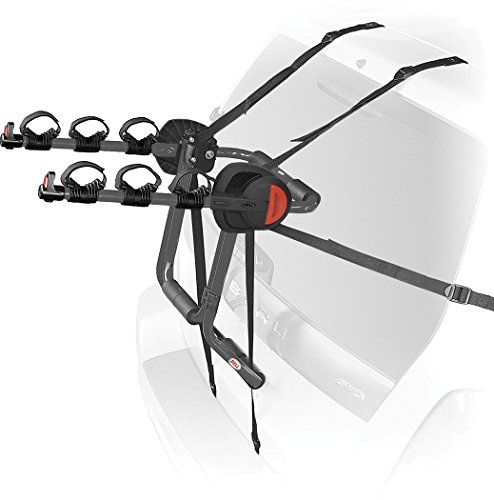
A trunk rack is the gentlest entry into bike hauling, and this Bell keeps the learning curve nearly flat. There’s no hitch receiver to buy and no drilling involved; six straps anchor the unit to sedans, hatchbacks, or SUVs, and assembly needs zero tools.
The folding hub collapses in one motion, which matters more than it sounds when you’re stashing the rack behind seats between trips. Reflective red end caps add a bit of rear visibility in dusk traffic, a small touch that earns its keep on evening drives home from the trail.
Noteworthy Benefits
- Holds up to three bikes of different styles, so a road bike and a kid’s mountain bike can share one trip
- One-step folding means storage takes seconds, not a garage shelf
- No-tool setup suits anyone who’d rather ride than read an instruction manual
- Reflective end caps improve visibility during low-light driving
Small Caveats
- Strap-mounted designs can shift slightly on long highway runs, so re-check tension at fuel stops
- Trunk access is blocked while mounted, unlike tilting hitch models such as the Soarify below
Who Will Love This
Casual riders who want a light, affordable three-bike carrier without touching their car’s hitch.
A Better Fit Elsewhere
Heavier bikes and frequent highway miles are better served by the JOYTUTUS 4-Bike Hitch Bike Rack, whose receiver mount removes strap tension worries entirely.
Allen has been making trunk racks longer than most brands in this category, and the Deluxe+ shows that experience. Its 100-pound rating comfortably covers two adult bikes, and the individual tie-down system lets you adjust each cradle separately instead of fighting a shared bar.
Fitment is the headline here: sedans, hatchbacks, minivans, and SUVs all work, which makes this a sensible choice for households with more than one vehicle. Compared with the Bell above, you give up a third bike slot but gain a heavier per-bike ceiling and finer adjustment control.
Key Advantages
- 100-pound total capacity handles two full-size adult bikes without strain
- Individual tie-downs let each frame sit at its own angle, reducing contact between bikes
- Wide vehicle compatibility covers most family garages with one purchase
- Padded contact points help keep paint scratches off bumpers and hatches
Points To Note
- Owners commonly report that straps need a snug re-tighten after the first few miles
- Two bikes is the hard limit; growing families should look at the four-slot options further down
At A Glance
Made For
Couples or parent-child pairs who drive mixed vehicles and want a dependable two-bike setup.
Swap It Out When
Three or more bikes per trip point toward the Amazon Basics 4-Bike Hitch Rack, which doubles the slot count for group outings.
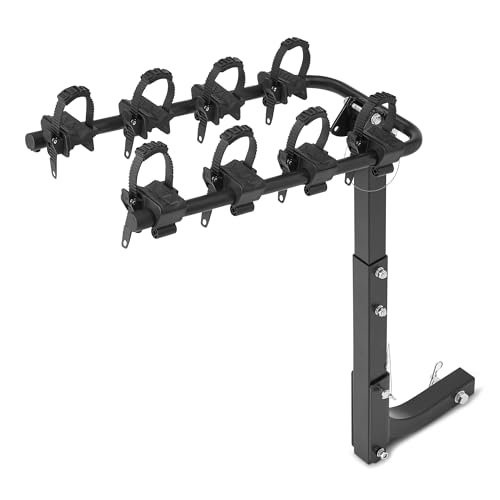
A hitch receiver is the 2-inch square socket at the back of many SUVs and trucks, and this rack slots straight into it. Four bikes, 132 pounds of rated load, and a folding steel frame make it the workhorse option here for family camping weekends or group training rides.
The anti-rattle mechanism addresses the classic hitch-rack complaint: wobble noise on rough pavement. Powder-coated steel shrugs off rain and road salt better than bare metal, though the coating will chip where straps rub, so a quick inspection each season keeps rust away.
Strengths Worth Knowing
- Four-bike capacity turns one vehicle into the whole carpool
- Folding design tucks flat against the vehicle or into a garage corner between trips
- Anti-rattle stability cuts down the clanking that cheaper hitch racks develop over time
- Powder-coated finish resists weathering through wet seasons
Things To Consider
- Requires a 2-inch hitch receiver, so smaller cars without towing hardware are out of luck
- Loaded weight adds meaningful tongue load; check your vehicle’s hitch rating before maxing out
- Rear cargo access is limited unless the rack is tilted or removed
Quick Facts
Right Fit For
Families and friend groups who already own a hitch-equipped SUV, truck, or crossover.
Where A Sibling Pick Shines
Anyone hauling e-bikes should step up to the TRAILXPERT platform rack, whose wider tire trays suit heavier electric frames.
RV and truck owners often get overlooked by rack makers, but this Soarify lists those vehicles among its targets alongside cars and SUVs. The tilt-release function swings the loaded rack down and away from the tailgate, so you can reach a cooler or gear bag without unloading four bikes first.
Rubber straps are the detail worth noticing. Metal hooks chew through paint and carbon fiber; rubber-wrapped ties grip the frame gently, which matters if any of your fleet wears a premium finish. At 143 pounds across up to four bikes, the per-bike allowance sits around 35 pounds, enough for most acoustic bikes but tight for heavyweight e-bikes.
Good Reasons To Consider
- Tilt release opens tailgate access without removing bikes or the rack
- Rubber straps protect painted and carbon frames from scuffing
- Explicitly suited to cars, SUVs, and RVs, broadening its usefulness beyond commuter vehicles
- Steel construction holds up to repeated loading cycles
Less Ideal Details
- The roughly 35-pound per-bike cap rules out many full-suspension e-bikes
- Four hanging bikes side by side can contact each other on rough roads; padding helps
Who Should Grab It
Truck and RV drivers carrying three or four conventional bikes who value tailgate access mid-trip.
Consider Something Else When
E-bike owners will find the JOYTUTUS Hitch EBike Rack with Ramp far easier on the back, thanks to its roll-on loading design.
Platform racks hold bikes by the wheels rather than the frame, and that single difference changes everything for e-bike and fat-tire owners. Wheels clamp onto trays, so no adapter bar is needed around odd frame shapes, and the battery stays put during loading.
This TRAILXPERT accepts tires up to 5 inches wide, which covers every fat bike currently sold, and its 160-pound total rating absorbs two hefty electric builds. Padded clamps, a safety strip, and an anti-theft locking pin round out a security package that hanging racks like the Allen units simply can’t match.
Notable Gains
- Wheel-mounted trays accept fat tires up to 5 inches, including e-bike wheel sizes
- 160-pound capacity carries two heavy electric bikes without strain
- Tilting mechanism drops the rack for hatch or tailgate access even when loaded
- Padded clamps plus a locking pin deter theft and frame damage together
What To Weigh
- Two-bike limit only; larger groups need the JOYTUTUS four-slot model instead
- Platform racks carry more inherent weight than hanging styles, which you’ll feel during installation
Feature Snapshot
The Right Fit
E-bike commuters and fat-tire trail riders who want frame-free carrying with real locking security.
Reach For A Different Pick When
Carrying more than two bikes calls for the JOYTUTUS 164-pound four-bike rack, which trades platform trays for greater headcount.
Theft is the anxiety nobody mentions until it happens at a trailhead rest stop. This JOYTUTUS answers with two locks: one pins the rack itself to the hitch, and an integrated cable secures the bikes to the rack. That’s a rare pairing at this capacity level.
Setup is refreshingly short. The unit arrives mostly assembled, needing just three bolts to finish, and a red knob tightens the base into the receiver. A switch buckle folds the carrier flat for storage, and turning the knob tilts it forward for trunk access, echoing the convenience of the Soarify but with an extra bike slot and stronger anti-theft hardware.
Strong Points
- Dual-lock system secures both the rack and the bikes against opportunistic theft
- 164-pound capacity spans four bikes, enough for a family of riders
- Nearly pre-assembled; three bolts stand between the box and the road
- Fold-and-tilt design covers both storage and tailgate access scenarios
Points To Keep In Mind
- At about 27 pounds unloaded, lifting it onto the hitch is a two-hand job for some users
- Hanging-style carriers still allow some bike-to-bike sway compared with platform trays
Who It Suits Best
Multi-rider households parking at busy trailheads where leaving bikes unattended is unavoidable.
Not Your Match When
Riders wanting wheel-tray protection for carbon frames will prefer the TRAILXPERT platform rack’s clamping design.
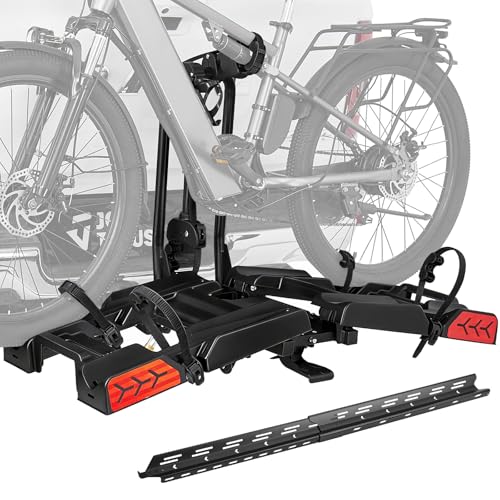
Lift a 70-pound e-bike onto a hitch tray once and you’ll understand why loading ramps exist. This JOYTUTUS includes one, letting you walk each bike up onto the deck instead of deadlifting it, and the 200-pound rating leaves generous headroom for two fully equipped electric builds.
The integrated structure ships ready to use with no assembly, and built-in handles plus four rolling wheels mean you can move the whole thing around the garage like luggage. Fat tires up to 5 inches fit the trays, matching the TRAILXPERT’s width range while adding the ramp and mobility features that rack costs extra for elsewhere.
Where It Excels
- Included ramp eliminates heavy lifting, a genuine back-saver with e-bikes
- 200-pound capacity covers two large electric bikes with room to spare
- No-assembly integrated frame works right out of the box
- Wheels and carry handles simplify garage storage and vehicle positioning
Honest Caveats
- Integrated build means a bulkier footprint than folding hanging racks for apartment storage
- Two-bike maximum won’t serve larger riding groups
The Details
Built With In Mind
E-bike owners who ride solo or with one partner and dread hoisting heavy frames onto a rack.
Another Choice May Suit
Groups of three or four on standard bikes get better value from the JOYTUTUS 164-pound four-bike carrier.
Some purchases don’t need deliberation, and this is one of them. The Model 102DN-R arrives fully assembled, straps onto sedans, hatchbacks, minivans, and SUVs in moments, and stores flat in a closet when the season ends. For occasional riders, that simplicity is the entire product.
Two thoughtful touches separate it from generic trunk racks: a padded lower frame keeps bikes clear of the vehicle body, and the patented lower strap anchors the bottom hook so it can’t slide loose mid-drive. Next to the pricier Deluxe+, you lose some adjustability but keep the core carrying job done well.
Everyday Wins
- Ships fully assembled; installation genuinely takes seconds
- Padded lower frame creates a buffer between bikes and paintwork
- Anchored lower strap resists slipping during bumpy drives
- Fits a broad range of vehicle types without adapters
Trade Offs
- Two-bike limit with shorter 12-inch carry arms than the Deluxe+ offers
- Trunk-mounted racks generally need periodic strap checks on long trips, as owners widely report
Whose Shelf It Belongs On
Occasional weekend cyclists who want the simplest possible two-bike solution at a modest cost.
Look Elsewhere When
Frequent users wanting finer per-bike adjustment should step up to the Allen Sports Deluxe+ trunk carrier reviewed earlier.
Choosing Between Trunk Straps And Hitch Hardware
Match The Mount To Your Vehicle
A hitch receiver is non-negotiable for the four hitch racks on this list. Sedan and hatchback drivers without towing hardware belong in the trunk-mount camp, where the Bell and both Allen models install with nothing but straps. Verify your receiver size before ordering; every hitch pick here assumes the standard 2-inch opening, and a mismatched receiver means a return shipment instead of a ride.
Weight Is The Silent Dealbreaker
Add up your heaviest realistic load, batteries included. Two acoustic mountain bikes rarely exceed 60 pounds combined, which the Allen units handle easily. A pair of full-power e-bikes can push past 130 pounds, territory reserved for the TRAILXPERT and the 200-pound JOYTUTUS. Exceeding a rated capacity stresses straps, welds, and your vehicle’s tongue-weight limit alike.
Think About Access And Storage
Tailgate access sounds minor until you’re unpacking camping gear behind a loaded rack. Tilting models, the Soarify and both JOYTUTUS hitch units, solve it. Garage space matters too: folding hanging racks store slimmer than integrated platform decks with wheels.
Key Considerations Across These Picks
Wrong Turns To Avoid
The most common mistake is buying for today’s bike and forgetting tomorrow’s. An entry-level rack bought for a hybrid becomes useless the moment an e-bike joins the garage. Also resist eyeballing fitment: check your specific vehicle against the manufacturer’s compatibility guidance, since spoilers, spare tires, and hatch shapes all interfere with strap mounts.
Where The Extra Money Goes
Higher-tier racks spend their budget on steel gauge, locking hardware, and loading aids. That ramp on the premium JOYTUTUS isn’t a gimmick; it converts a two-person lift into a one-person stroll. Paying up pays off most for e-bike owners and weekly riders, while occasional users rarely feel the difference.
Bottom Line
Your bike count and bike weight answer most of this decision for you. Casual riders with a sedan will be happy with either Allen trunk rack or the Bell, while hitch-equipped households carrying three or four standard bikes land naturally on the Amazon Basics or the lock-equipped JOYTUTUS. E-bike owners should treat the ramp-equipped 200-pound JOYTUTUS as the default starting point. Measure your receiver, weigh your bikes, and the right pick sorts itself out quickly.
