

AGM batteries like steady charging, clear status, and less guesswork than a loose wall of numbers can provide. You get more value from a charger that matches your battery type, your storage space, and how often you keep a car, truck, motorcycle, or tractor on standby. This roundup focuses on chargers that make sense for everyday garages, seasonal vehicles, and maintenance tasks that should feel calm instead of fussy.
Quick Look At Our Shortlist

Schumacher Electric Wheeled 10A Charger SC1446

Huiaipaic 12-Amp Smart Battery Charger

Battery Tender 15 AMP Charger and Maintainer 022-0234-DL-WH

PCHH 12V 24V Heavy Duty Car Battery Charger

PZ.P 15-Amp 12V/24V Smart Battery Charger
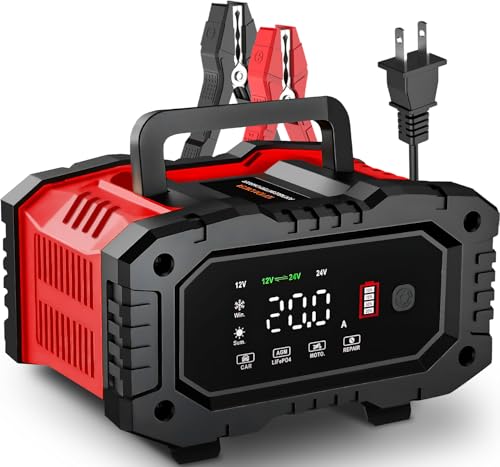
Huiaipaic 20-Amp Car Battery Charger 300W

VEVOR Smart Battery Charger 35-Amp LCD Display

VibeXtr 1.5A 6V/12V Car Battery Charger
More Details On Our Top Picks
The SC1446 suits you when a garage charger needs to feel more hands-on than automated. Its wheeled frame gives it a shop-tool feel, and that matters in a barn, driveway, or older-car setup where you move the unit around often.
The manual approach can be a plus for deeply drained batteries that confuse lighter smart units, though it also asks for more attention from you. Compared with the Battery Tender pick later in this list, this Schumacher is better for someone who wants direct control and does not mind a more old-school rhythm.
Strong Points
- Wheeled design makes movement easier in a busy garage.
- Manual control gives you more say over the charge process.
- Strong engine-start and boost output suits larger vehicle recovery needs.
- Good fit for older batteries that need a less fussy charger.
Things To Consider
- You get more control, but also more responsibility during use.
- The larger footprint is less friendly to tight shelf storage.
- Manual operation can feel less convenient for casual top-offs.
Feature Snapshot
Who It Suits Best
You fit this charger well if you keep older vehicles, tractors, or project cars in a garage and want direct control instead of a fully automatic routine.
Where A Sibling Pick Shines
Battery Tender 15 AMP Charger and Maintainer 022-0234-DL-WH suits you better for regular maintenance on a battery that stays connected for long stretches.
This Huiaipaic model stands out for its wide chemistry support, which helps you keep more than one kind of battery in rotation. In a garage with a boat, motorcycle, and lawn tractor, that flexibility cuts down on tool clutter.
The trade-off is that a long feature list can feel busier than the simpler Battery Tender unit, so you may appreciate it most when your batteries vary a lot. The pulse-repair style function also gives it a more recovery-minded profile than the Schumacher above, which leans harder into manual control.
What We Like
- Works with lithium and several lead-acid types, including AGM and gel.
- Handles both 12 volt and 24 volt battery setups.
- Useful for mixed garages where one charger needs to cover several machines.
- Smart charging and maintenance support daily use without much fuss.
Worth Noting
- The broader feature set may take a little longer to learn.
- Multi-vehicle households will still need to match settings carefully.
- The listing suggests a lot of modes, so keeping the manual handy helps.
Core Details
Built With In Mind
You suit this charger best if your garage includes different battery chemistries and you want one unit to handle maintenance across several machines.
Look Elsewhere When
PZ.P 15-Amp 12V/24V Smart Battery Charger works better for you if temperature compensation and a more structured charging routine matter more than broad compatibility alone.
This Battery Tender model feels like the calm, practical choice in the group. The switchable output levels give you room to match the task, so a routine maintenance job does not feel like overkill.
It makes especially good sense for a vehicle that sits for stretches, since a charger with float-style maintenance can hold a battery at a steady level after the initial charge. Compared with the Huiaipaic 12-Amp option, this one is less about broad chemistry bragging and more about familiar, straightforward upkeep.
Upsides
- Three charging levels let you tailor output to the battery and job.
- Selectable chemistry support helps with AGM, gel, and standard lead-acid use.
- LCD feedback is handy in dim garages or shared storage spaces.
- Compact size makes it easier to tuck away than the wheeled Schumacher unit.
Room For Improvement
- Less appealing for anyone who wants a heavy-duty, shop-style charger.
- The compact format is convenient, though it gives up the rolling mobility of the Schumacher.
- Best suited to routine upkeep rather than rough recovery work.
Details At A Glance
Who Should Grab It
You fit this charger well if you want a tidy, set-and-manage option for a garage battery that sees seasonal use or long storage gaps.
Another Choice May Suit
Huiaipaic 20-Amp Car Battery Charger 300W makes more sense for you if faster turnaround and a higher output ceiling matter more than a compact maintenance tool.
The PCHH model brings a heavier, more workshop-minded build than the Battery Tender above. With its copper coil, metal housing, and ABS shell, it reads like a unit meant to stay useful through regular garage wear rather than sit pretty on a shelf.
You may appreciate the automatic detection of 12 volt and 24 volt batteries because it takes some of the second-guessing out of setup. That said, the 12.2-pound weight is worth keeping in mind for storage or carrying between jobs.
Best Bits
- Heavy-duty construction suits frequent garage use.
- Automatic voltage detection reduces setup friction.
- Supports a broad range of lead-acid battery types, including AGM.
- Fast and trickle modes give you more control over pacing.
Softer Spots
- The heavier frame is less convenient for small shelves or travel kits.
- More physical heft usually means you plan storage a bit more carefully.
- Power-focused gear can feel overbuilt for simple maintenance jobs.
Feature Rundown
Right Fit For
You fit this charger best if you keep trucks, motorcycles, or utility gear in one place and want a heavier unit that feels ready for repeat use.
Skip It When
VibeXtr 1.5A 6V/12V Car Battery Charger suits you better if you need something light, compact, and easy to store with a small battery tender setup.
The PZ.P charger leans into automatic charging logic, which is handy in a mixed garage where you want less guesswork and more consistency. The 9-stage structure suggests a more guided charging process than the simpler options in this roundup, and that often suits people who keep several batteries in rotation.
Temperature compensation is the detail that separates it from the Huiaipaic 12-Amp unit, especially in sheds, barns, or seasonal spaces that swing hot and cold. The honest read is that you get more structure here, but also a slightly more specialized tool for people who care about controlled maintenance.
Reasons To Buy
- Automatic 9-stage charging gives you a more managed process.
- Temperature compensation is useful in unheated storage spaces.
- Supports both LiFePO4 and lead-acid batteries, including AGM.
- Works for a wide mix of vehicles and small equipment.
Areas To Watch
- The feature set may feel more technical than a basic maintainer.
- It helps to know your battery type before setting up.
At A Glance
Made For
You fit this charger well if you keep seasonal vehicles or farm equipment in storage and want a smarter, more guided maintainer.
Where Shoppers Go Wrong
Schumacher Electric Wheeled 10A Charger SC1446 suits you better if you want manual control and a heavier shop tool for revival work.
This Huiaipaic charger pushes harder than the PZ.P model, and that higher current ceiling is the main reason it belongs on this list. In a shop setting, faster turnaround matters, especially for trucks, RVs, and equipment that keep returning to service.
The 300W rating and 20 amp 12 volt output make it more aggressive than the 15 amp picks above, though that also means it feels better suited to users who already know their battery needs. You may find it a touch much for gentle maintenance, but it makes sense for larger batteries that benefit from a stronger push.
Highlights
- Higher output helps reduce waiting time for larger batteries.
- Supports AGM, gel, SLA, VRLA, flooded, calcium, and LiFePO4 types.
- Works across cars, trucks, RVs, and powersports gear.
- Desulfator function adds extra value for storage-heavy use.
Minor Gripes
- More power is not always the gentlest fit for small batteries.
- The broader mode set calls for more care during setup.
Quick Facts
Whose Shelf It Belongs On
You fit this charger best if you want faster charging for larger vehicles, deep-cycle batteries, or a busy garage with frequent turnover.
A Better Fit Elsewhere
Battery Tender 15 AMP Charger and Maintainer 022-0234-DL-WH suits you better if you value a gentler, more compact maintainer for long storage periods.
The VEVOR unit brings the widest current ceiling in this roundup, so it naturally leans toward heavier garage use. For people managing several vehicles or maintenance cycles, that extra headroom can make the work feel less drawn out.
Its LCD display helps keep status checks simple, which is useful when a charger lives in a shared workshop and different people use it. The trade-off is straightforward, higher output and broader mode support usually mean a more involved setup, so this suits hands-on owners more than casual top-off users.
Bright Spots
- 35-amp output gives it a strong capacity advantage.
- Works with lithium, LiFePO4, and lead-acid battery families.
- LCD display supports clearer status checks.
- Well suited to busy garages and fleet-style routines.
Small Caveats
- The broader reach comes with a more involved setup feel.
- High output makes it less of a casual shelf companion.
- You may not need this much capacity for one small battery.
Core Details
Built For
You fit this charger best if you maintain multiple vehicles, run a busy workshop, or want stronger output for larger batteries.
Swap It Out When
VibeXtr 1.5A 6V/12V Car Battery Charger suits you better if your main goal is quiet maintenance for a small battery that stays parked for long periods.
The VibeXtr charger is the smallest, calmest option here, and that’s the point. It suits you when the battery lives in a classic car, motorcycle, lawn tool, or storage situation where slow upkeep matters more than speed.
Temperature compensation is a quiet but useful feature, especially in garages that swing from warm afternoons to cold nights. Compared with the larger VEVOR and Huiaipaic models, this one is easier to store and less likely to feel like too much charger for a modest battery.
Positives
- Compact body is easy to store in a small garage.
- 1.5 amp output suits slow maintenance work.
- Works with 6 volt and 12 volt batteries.
- Temperature compensation helps it adapt to changing conditions.
- Pulse repair mode adds value for batteries that need attention.
Points To Note
- The low output is not built for fast turnaround.
- Best suited to smaller batteries and maintenance duties.
- Some users may want a larger screen or more status detail.
Key Specs
The Right Fit
You fit this charger best if you own smaller vehicles or seasonal equipment and want a compact maintainer that stays out of the way.
Reach For A Different Pick When
VEVOR Smart Battery Charger 35-Amp LCD Display suits you better if you need stronger output for several batteries or a busier shop routine.
How To Choose The Right Battery Chargers For Agm Battery
Match Output To The Job
AGM batteries usually do best with a charger that fits the task instead of one that simply pushes hard. A 1.5 amp or 2 amp maintainer suits storage and seasonal use, while 10 amp to 20 amp models make more sense for charging after downtime or for larger batteries in trucks and boats. The real question is not power for its own sake, it’s whether you want gentle upkeep, routine charging, or faster shop turnaround.
That’s why the Battery Tender and VibeXtr picks feel comfortable for long sitting periods, while the VEVOR and Huiaipaic 20-Amp charger serve busier garages. More current can shorten wait time, but it can also make the unit feel less relaxed for delicate, smaller batteries. Choose the output range that matches the battery size you actually keep on hand.
Look Closely At Battery Chemistry Support
AGM is part of the lead-acid family, so the charger has to recognize it properly and not treat it like a generic battery. A charger that also names gel, SLA, flooded, or LiFePO4 support gives you more flexibility, especially in a garage with mixed equipment. That flexibility matters most when you own a motorcycle, lawn mower, truck, and boat, not just one car.
The Huiaipaic 12-Amp and VEVOR models make sense for mixed setups because they cover more than one chemistry, while the PZ.P unit adds LiFePO4 to the mix with a more structured charging routine. If your battery shelf is a small collection rather than a single AGM battery, that broader support saves you from owning separate chargers for every machine.
Think About Maintenance Versus Recovery
Some chargers are better at keeping a healthy battery topped off, and others are built to deal with deeper discharge situations. Maintenance-focused units are gentler and easier to live with, especially for vehicles that sit through winter or between weekend drives. Recovery-oriented options, like models with pulse repair or manual control, are more appealing when you deal with older batteries or machines that have been neglected.
Schumacher leans toward direct, hands-on recovery work, while the VibeXtr and Huiaipaic smart units feel more like regular caretakers. That difference matters because a charger can be great at one job and merely adequate at another. A seasonal driver usually wants upkeep, while a garage full of older equipment may justify a stronger recovery tool.
Size, Storage, And Daily Convenience
Compact chargers are easier to store on a shelf, toss in a cabinet, or keep with roadside gear. Larger wheeled or heavy-duty units feel more at home in a workshop because they trade portability for sturdier build and higher output. Neither approach is wrong, but the better one matches how often you move the charger around.
The Schumacher unit is the clearest example of a shop-first design, while VibeXtr is easier to tuck away in a tight space. LCD screens, automatic shutoff, and temperature compensation can also make daily use smoother, especially in dim garages or climate swings. A charger that feels easy to check is more likely to be used regularly, and regular use matters more than fancy language on the box.
Things Worth Knowing First
Wrong Turns To Avoid
Many shoppers grab a charger based on amperage alone and forget to check battery type. That can leave you with a tool that’s more forceful than useful, or one that doesn’t line up with AGM, gel, or LiFePO4 needs. Matching the charger to the battery chemistry is the quiet step that saves a lot of annoyance later.
Another common miss is ignoring storage space. A wheeled heavy-duty unit sounds appealing until you need to fit it beside a compressor, fuel cans, or lawn gear. Smaller garage setups usually benefit from a compact maintainer, even when a larger charger looks more impressive on paper.
When Paying More Pays Off
Higher-tier chargers usually cost more because they add stronger current output, broader chemistry support, LCD readouts, or more controlled charging stages. Those extras matter most when you maintain several vehicles, charge in variable temperatures, or need faster turnaround in a busy garage. You are paying for flexibility and convenience, not just for a number on the label.
The upgrade makes sense for people who keep a truck, a boat, and a seasonal car in rotation. A basic maintainer can be enough for one AGM battery, though a smarter, more versatile unit earns its keep once your setup gets larger and more varied. That’s where the extra money tends to feel justified.
Closing Thoughts
The best charger for your AGM battery depends less on brand name and more on how your battery actually lives. A simple maintainer works well for storage and seasonal use, while a heavier, higher-output model fits garages with older vehicles or multiple batteries in play. The shortlist above gives you a clean spread from compact upkeep to serious shop duty. Pick the one that matches your space, your charging routine, and how often you need the battery ready.
