

Battery trouble rarely shows up at a good time. A truck that sits through winter, an older car with a tired battery, or a tractor that only wakes up on weekends all need different kinds of charging support, and the wrong unit can feel clumsy fast. This roundup helps you match the charger to your garage habits, not just the label on the box. You’ll see which models suit quick starts, long-term maintenance, and heavier-duty work.
Quick Look At The Shortlist

Schumacher Electric Wheeled 10A Charger SC1446

Schumacher Electric Wheeled 6A Charger SC1364

CRAFTSMAN 12A Charger CMXCESM258

DeWalt DXAEC100 30 Amp Charger

Schumacher Electric Wheeled 6A Charger SC1353

PCHH 12V 24V Heavy Duty Charger

PZ.P 15-Amp 12V/24V Smart Charger
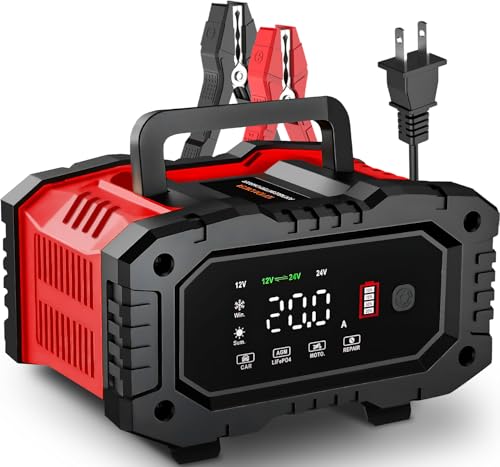
Huiaipaic 20-Amp Car Battery Charger

Schumacher Electric 8A Charger SC1363
More Details On Our Top Picks
The SC1446 suits the kind of garage work where control matters more than a polished screen. Its wheeled frame helps when you move between bays, and the 10-amp charge rate gives you more pace than a tiny maintainer without jumping into overkill territory.
That makes sense for older cars, tractors, and weekend equipment that can sit for stretches. The honest trade-off is that a manual-style charger asks more attention from you, so it fits people who like hands-on control rather than a set-it-and-walk-away routine.
Strong Points
- Wheeled design makes it easier to roll around a garage floor.
- 10-amp charging gives you a practical middle ground for recovery and upkeep.
- Works well in older-vehicle scenarios where a simple, direct charger is welcome.
- The straightforward layout suits owners who prefer clear physical control over menu layers.
Things To Consider
- The manual approach asks for more attention than a fully automatic smart unit.
- The larger wheeled format takes more storage room than a compact bench charger.
- It feels most natural in a garage or workshop, not in a carry-along trunk kit.
Feature Snapshot
Who It Suits Best
You’ll like this most if you work on older vehicles, tractors, or garage machines and want a charger that feels direct and sturdy.
Where A Sibling Pick Shines
Schumacher Electric Wheeled 6A Car Battery Charger & Maintainer SC1364 is a gentler fit for routine maintenance and lighter household use.
The SC1364 keeps the same wheeled, workshop-friendly feel as the SC1446, but it leans more toward steady upkeep than brisk recovery. That slower, calmer pace works well for owners who keep a battery connected over time and want something that feels less aggressive.
For a car, truck, SUV, or marine battery that spends part of its life parked, that balance makes sense. The trade-off is obvious, though, since a 6-amp unit will not feel as punchy as the 10-amp Schumacher above when a battery needs a stronger push.
Highlights
- Wheeled format helps you move it around a garage without dragging it by hand.
- 6-amp output suits ongoing battery care and lighter recovery work.
- The pacing feels friendlier for owners who want a less aggressive charge cycle.
- Useful for vehicles that sit between drives, including seasonal and marine setups.
Worth Noting
- It gives up some speed compared with higher-amp chargers in this roundup.
- The larger footprint makes sense on a floor or shelf, less so in a tiny storage bin.
- You still need a bit of patience for a slower, maintenance-first workflow.
At A Glance
Made For
You’ll get the most from it in a home garage or driveway setup where steady battery care matters more than raw speed.
A Better Fit Elsewhere
DeWalt DXAEC100 30 Amp Battery Charger suits you better if faster recovery and a stronger engine-start role matter more.
The CRAFTSMAN CMXCESM258 stands out because it covers a broad spread of battery types without forcing you to sort through a bunch of separate tools. It’s the kind of charger that feels useful in a mixed garage, especially when your gear spans standard, AGM, lithium iron phosphate, and deep-cycle needs.
Its automatic detection helps reduce guesswork, which is handy for casual owners who want the charger to do the thinking. The trade-off is that you’re paying for that broader feature set, so it’s less appealing if you only need a basic maintainer for one simple 12V battery.
Reasons To Buy
- Supports several battery types, which helps in garages with more than one kind of equipment.
- Automatic detection lowers the chance of choosing the wrong charge mode.
- The 12-amp rapid mode gives you a faster option when time matters.
- Separate 6V and 12V maintenance rates add flexibility for mixed-use ownership.
Minor Gripes
- All that flexibility can feel like more charger than a single-vehicle owner needs.
- The feature set makes the learning curve a bit less bare-bones than simpler units.
- It makes the most sense for people who will actually use the extra battery support.
Core Details
Right Fit For
You’ll appreciate it most in a home garage with varied equipment and a real need for adaptable charging.
Another Choice May Suit
Schumacher Electric Wheeled 6A Car Battery Charger & Maintainer SC1364 is easier to live with if you want a simpler maintenance-first machine.
The DXAEC100 brings a more forceful profile than the Schumacher models earlier in the list. With a 100-amp engine start, a 30-amp charge mode, and a 3-amp maintainer, it suits people who want a charger that can move from recovery to upkeep without feeling tame.
The alternator check is useful because it gives you a basic look at how the vehicle’s charging system is behaving, which helps in a busy driveway or shop. The trade-off is that this is more charger than casual users need, so its value shows up most clearly in serious garage routines.
What We Like
- Higher charge output helps cut down waiting time for demanding recoveries.
- The engine-start function adds real flexibility for vehicle-heavy households.
- Alternator checking brings another layer of practical troubleshooting.
- Its 3-amp maintainer mode keeps the unit useful between bigger jobs.
Small Caveats
- It makes more sense for active garages than for occasional top-offs.
- The heavier-duty profile can feel like too much machine for a simple sedan battery.
- Storage and handling take a bit more room than lighter maintainers.
Details At A Glance
Best Suited To
You’ll find it most useful in a garage where you work on vehicles often and want stronger output from a single unit.
Swap It Out When
Schumacher Electric Wheeled 6A Car Battery Charger & Maintainer SC1364 fits better for quieter, slower battery care around the house.
The SC1353 feels like an old-school shop tool that still makes sense now. It’s wheeled, it handles 6V and 12V batteries, and it suits the sort of routine that involves keeping cars, tractors, and utility vehicles ready without fuss.
Compared with the SC1364, it serves a similar role, so the real difference often comes down to which layout or feature set feels better in your garage. The honest read is that this is a straightforward workhorse, not a flashy machine, and that’s exactly why some owners will prefer it.
Best Bits
- Wheeled design helps in larger garages where the unit may need to move often.
- 6V and 12V support covers a broad range of common garage equipment.
- Its plain setup keeps the focus on charging rather than menu digging.
- Works well for garage and farm routines that value dependable utility.
Points To Note
- It shares a similar lane with the SC1364, so the distinction is mostly in fit.
- The wheeled body is convenient, but it also needs more storage room than a small maintainer.
- You’ll want a place where the charger can stay set up instead of being moved daily.
Quick Facts
Whose Shelf It Belongs On
You’ll get along with it best in a garage or farm setup where simple, sturdy charging matters.
Look Elsewhere When
DeWalt DXAEC100 30 Amp Charger suits you better if your work leans toward stronger recovery and faster turnaround.
The PCHH charger brings a heavy-duty feel that matches larger vehicles and equipment better than the lighter maintenance units above. Its 0 to 15-amp automatic range, plus 12V and 24V support, gives it room to handle more demanding garage jobs.
The copper coil, metal, and ABS housing also suggest a sturdier build than many lightweight chargers, though that extra body weight means it belongs in a permanent or semi-permanent spot. For truck owners, boat storage, and equipment sheds, that trade-off usually feels reasonable.
Upsides
- Automatic charging helps reduce guesswork during routine use.
- 12V and 24V support opens the door to larger vehicles and equipment.
- The build materials point toward a sturdier workshop presence.
- Trickle-charging behavior makes it useful for long-term battery upkeep.
Areas To Watch
- The heavier build is less appealing for frequent carrying.
- It makes the most sense where storage space is already set aside for tools.
- Owners who only need light top-offs may find the unit more than they need.
Feature Rundown
Built With In Mind
You’ll appreciate it most in a truck bay, shed, or garage where a durable charger can stay near the workbench.
Another Choice May Suit
Schumacher Electric 8A Car Battery Charger & Maintainer SC1363 is easier to handle for lighter everyday battery care.
The PZ.P unit leans into automation in a way that feels friendly for owners who want more guidance from the charger itself. Its 9-stage charging process and temperature compensation matter because they help the unit adjust its behavior instead of acting like a blunt, one-speed tool.
That makes it appealing for motorcycles, lawn equipment, cars, and boats that see changing conditions through the year. The catch is that the extra logic is only useful when you want a smarter charging routine, so it’s not the simplest pick in the list.
Bright Spots
- 9-stage charging gives the unit a more deliberate charging sequence.
- Temperature compensation adds practical value across changing garage conditions.
- 12V and 24V support broadens its use across different machines.
- It suits owners who prefer a charger that handles more of the process on its own.
Softer Spots
- The added automation can feel more involved than a bare-bones maintainer.
- It makes sense when you want features, less so for the simplest top-off duty.
- The strongest appeal comes from its charging logic, not from a stripped-down design.
Technical Sheet
Perfect Match For
You’ll like this most in a garage where smart charging behavior matters as much as output.
Reach For A Different Pick When
Schumacher Electric Wheeled 6A Car Battery Charger & Maintainer SC1364 suits you better if you want a simpler, slower-maintenance routine.
The Huiaipaic charger pushes harder than the more modest maintainers in this roundup, and that stronger output is the whole point. With 12V and 24V support plus compatibility across LiFePO4 and lead-acid battery families, it’s built for garages where a single charger needs to do a lot.
Its desulfation function is worth noting because it’s aimed at helping with sulfate buildup on lead-acid batteries, which is useful in aging equipment and seasonal vehicles. The trade-off is that the broader feature set makes it better suited to people who will actually use those extra modes instead of just plugging in once a year.
Standout Traits
- 20-amp charging gives you a strong pace for heavier recovery jobs.
- 12V and 24V support widens its usefulness in mixed garages.
- Works with several battery chemistries, which adds real flexibility.
- Desulfation support gives older lead-acid batteries an extra maintenance tool.
Room For Improvement
- The broader feature list can feel like more than a casual owner needs.
- It makes more sense in a garage that sees regular battery work.
- Extra modes add value, but they also add a little more to learn.
Core Details
Who Should Grab It
You’ll get the most value from it if your garage mixes cars, lawn gear, trucks, or marine equipment.
Look Elsewhere When
Schumacher Electric 8A Car Battery Charger & Maintainer SC1363 suits you better for simpler, lighter duty charging.
The SC1363 sits in a very usable middle ground, with enough output for practical charging and enough restraint to stay friendly for maintenance work. It handles 6V and 12V systems, so it fits a broad slice of cars, motorcycles, ATVs, and marine setups without feeling fussy.
Compared with the smaller 6-amp Schumacher options, this one gives you a bit more pace while keeping the same straightforward personality. That makes it a sensible middle path for owners who want one charger to handle daily upkeep and the occasional more serious battery recovery.
Standout Traits
- 8-amp output gives you more pace than the lighter 6-amp models.
- 6V and 12V support helps it cover more household and garage gear.
- Works with standard and AGM batteries, which adds useful compatibility.
- The pacing suits both regular upkeep and moderate charging jobs.
Worth Noting
- It is still a moderate-output unit, so huge batteries may call for more patience.
- Owners who want heavy-duty recovery will likely want a stronger charger.
- The design stays practical rather than flashy, which may be exactly the point.
Feature Card
The Right Fit
You’ll like it most if you want a steady, all-purpose charger for home garage use without moving into heavy-duty territory.
Skip It When
DeWalt DXAEC100 30 Amp Charger makes more sense when you need stronger output and a more aggressive recovery profile.
How To Choose The Right Battery Charger Automotives
Match Output To The Job
Charge rate tells you how quickly the charger can move energy into the battery, and the right number depends on how you actually use your vehicles. A 6-amp or 8-amp unit suits maintenance and lighter recovery, while 12-amp, 15-amp, or 20-amp models feel better when you deal with larger batteries or longer downtime. Higher output can save waiting, but it also makes the charger more machine than some casual owners need.
Think about the battery’s size, too, because a small motorcycle battery and a truck battery do not ask for the same pace. A charger that feels calm on a lawn mower may feel underpowered on a work truck, which is why matching output to the vehicle matters more than chasing the biggest number on the label.
Choose The Right Battery Types
Battery chemistry matters because different batteries respond to different charging styles. Lead-acid families such as AGM, GEL, and flooded types show up often in vehicles and equipment, while LiFePO4 calls for models that list that chemistry specifically. A charger with broad compatibility is useful in mixed garages, but it only helps when the listed battery types match what sits in your driveway or shed.
That is where the CRAFTSMAN and the Huiaipaic units stand out, since they cover more than one battery family. By contrast, a simpler charger can feel easier to live with when every vehicle uses the same basic battery type.
Decide How Much Automation You Want
Smart chargers bring steps such as multi-stage charging, temperature compensation, and automatic voltage detection. Those features help reduce guesswork and can make the routine feel smoother, especially for owners who leave batteries connected for long stretches or charge in changing weather. The trade-off is more complexity, which may feel unnecessary if you just want a plain maintainer for a single car.
Manual chargers appeal to people who want direct control and do not mind staying more involved. That style suits older vehicles, farm gear, and workshop use, while a fully automatic design tends to work better for busy households that want fewer decisions at the cord.
Think About Storage, Mobility, And Use Setting
Wheeled chargers earn their keep in garages, barns, and shop floors where the unit stays on site. They are easier to reposition, but they also ask for more storage space and usually make less sense for trunk carry or apartment storage. Compact units trade that rolling convenience for simpler placement on a shelf, bench, or floor corner.
You should also weigh how often the charger will move. A stationary battery maintainer feels right for a seasonal car or a weekend mower, while a more mobile, wheeled unit suits a busy workspace where several vehicles rotate through the same bay.
Things Worth Knowing First
Mistakes Worth Dodging
Many shoppers focus on amps alone and miss the battery chemistry on the label. That leads to awkward fit, especially with LiFePO4 batteries or mixed AGM and flooded setups. Another common slip is choosing a charger that is larger and more powerful than the job actually calls for, which adds cost and bulk without adding much value.
Storage also gets overlooked. A wheeled charger sounds handy, but it can be a poor fit in a cramped shed or trunk kit, while a compact unit may feel much easier to live with for light maintenance.
Where The Extra Money Goes
Higher-tier chargers usually pay for broader compatibility, smarter charging stages, stronger output, or extra diagnostic help such as alternator checks. Those upgrades matter most in garages that handle multiple vehicles or batteries that sit unused for long periods. You’re not just paying for speed, you’re paying for flexibility and fewer compromises.
The upgrade makes sense when you want one charger to cover cars, trucks, lawn gear, and seasonal equipment. For a single battery in regular use, a simpler model often makes more sense and keeps your setup cleaner.
Closing Thoughts
Your best choice depends on how demanding your vehicles really are. The Schumacher models suit straightforward garage use, the CRAFTSMAN and PZ.P picks add more control and battery-type flexibility, and the DeWalt and Huiaipaic units lean into stronger output for bigger jobs. Once you match amperage, chemistry, and storage style to your own setup, the shortlist gets much easier to narrow down. A charger that fits your routine will feel useful every season, not just on the first cold morning.
