

Warm air from your car vents often points to lost refrigerant, but the leak may sit behind a fitting, along a line, or in a cramped engine bay. You need a detector that matches your refrigerant type, working space, and comfort level with automotive repairs. Electronic sniffers suit repeat diagnostics, while UV dye kits give you a visible trail to inspect with a lamp and glasses. The six options below cover entry-level troubleshooting, infrared sensing, rechargeable operation, and dye-based inspection for home garages and mobile work.
The Shortlist At A Glance

Aprvtio WJL-6000PRO Refrigerant Leak Detector
Elitech ILD-200 Infrared Refrigerant Leak Detector

Elitech CLD-100 Refrigerant Leak Detector

Vansky Automotive AC UV Dye Leak Detection Kit

Tookie Fluorescent AC Leak Detector Kit

SENSYX SFD201 Refrigerant and Combustible Gas Leak Detector
More Details On Our Top Picks
DIY car maintenance becomes more approachable with a handheld sniffer paired with UV and LED lighting. The listed sensitivity reaches 0.14 oz per year, giving you a tool aimed at small refrigerant losses rather than only obvious failures.
That combination suits a warm-air diagnosis in a home garage, especially across R134a, R22, and R410A applications. You may find the mixed detection approach easier to work with than the dye-only Vansky kit, although checking a suspected spot still demands patience and a clean engine bay.
Strong Points
- Electronic sensing and UV illumination cover two inspection styles in one kit.
- The 0.14 oz-per-year sensitivity is suited to slow losses that aren’t visible at a glance.
- Broad refrigerant coverage helps DIYers work across different vehicle and home AC systems.
- The compact format is practical for storage in a garage tool drawer.
Things To Consider
- UV inspection depends on compatible dye already being present or added separately.
- Owners commonly need to keep the sensing area clean because residue can complicate repeat checks.
Key Specs
Who It Suits Best
Home mechanics and car enthusiasts needing a broad, approachable tool for occasional refrigerant troubleshooting.
Consider Something Else When
Choose the Elitech ILD-200 for frequent service work where infrared sensing and long sensor life matter more than UV assistance.
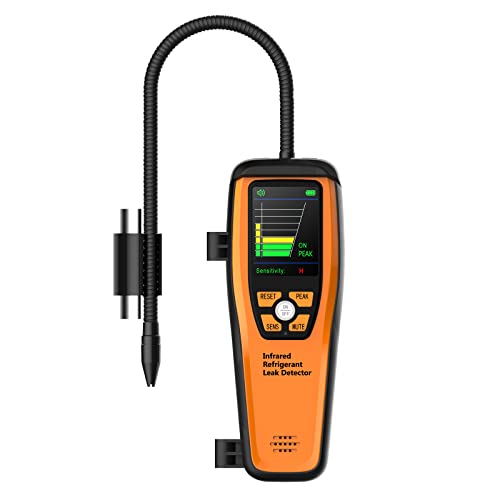
Infrared sensing uses changes in infrared energy to identify refrigerant, while a halogen sniffer is designed around halogenated gases. Elitech gives you three sensitivity levels and a sensor life listed at 10 years, a useful combination for repeated checks on vehicles or household systems.
Compared with Aprvtio’s UV-assisted design, the ILD-200 focuses more directly on electronic detection and interference resistance. The honest read is that its extra sensor emphasis makes more sense for a service-minded user than for someone checking a single aging car.
What We Like
- Infrared sensing is designed to respond quickly while limiting interference from surrounding conditions.
- High, medium, and low settings let you begin broad and then narrow the search.
- Coverage across halogen refrigerants supports automotive and HVAC applications.
- The stated 10-year infrared sensor life suits a tool that stays in regular rotation.
- Its gas-focused design avoids relying on visible dye during an initial scan.
Trade Offs
- There is no listed UV light or dye accessory, so visual confirmation requires a separate setup.
- Multiple sensitivity settings add control but require a little more judgment from beginners.
- Storage in a clean, dry case is sensible because the sensing head is the working component.
At A Glance
Made For
Technicians, serious home mechanics, and property owners who expect to diagnose refrigerant systems repeatedly.
Not Your Match When
The Vansky kit suits you better for a dye-based visual search with strong illumination and protective glasses.
Narrow engine bays reward a flexible probe, and the CLD-100 lists an approximately 8.26-inch reach for that purpose. Its corona sensor, a gas-sensitive electrical discharge design, uses an updated analogue circuit and a short six-second warm-up.
Six sensitivity levels give you finer adjustment than the ILD-200’s three. You may find the audible and visual alarms easier to follow beside a running vehicle, though the traditional sensor design may feel less refined than Elitech’s infrared option.
Highlights
- The flexible probe reaches around hoses and fittings that a rigid tip may miss.
- Six sensitivity settings help you narrow the source after an initial scan.
- Audible and visual leak alerts provide two ways to notice a signal in a noisy garage.
Minor Gripes
- The 0.21 oz-per-year sensitivity is less fine than the 0.14 oz-per-year rating listed for Aprvtio and ILD-200.
- Corona sensors can need careful handling around contamination, so probe cleaning and protected storage matter.
Technical Sheet
Right Fit For
DIY mechanics who regularly work around cramped automotive fittings and want detailed sensitivity adjustment.
A Better Fit Elsewhere
Aprvtio WJL-6000PRO fits you more closely for entry-level use that benefits from both electronic detection and UV lighting.
Visual dye inspection makes sense for a garage where you can take time to trace hoses, joints, and compressor areas. Vansky centers that approach around a 68-LED UV lamp and protective glasses, with the source material describing the lamp as 40% brighter than comparable flashlights.
Compared with the electronic Elitech CLD-100, this kit depends on dye reaching the leak and becoming visible under UV light. That can be easier to explain to a beginner, though dark or dirty components still demand close inspection and careful cleanup afterward.
Upsides
- The 68-LED layout supplies broad UV illumination for inspecting several nearby components.
- Protective glasses are included for the dye-viewing process.
- Visual confirmation can help you mark the exact area needing further service.
- The flashlight format stores easily with automotive hand tools.
Worth Noting
- The source data doesn’t state that dye is included, so you may need a compatible dye separately.
- UV results depend on sufficient dye circulation and a reasonably clean inspection surface.
- Flashlight batteries and lens cleanliness become part of routine ownership.
Feature Snapshot
Best Suited To
DIY car owners who prefer a visible dye trail and work in a garage with time for detailed visual inspection.
Where A Sibling Pick Shines
Elitech ILD-200 suits you better for immediate electronic refrigerant sensing without depending on a dye trail.
For an occasional car AC inspection, Tookie keeps the setup straightforward: fluorescent oil, a leak-detection flashlight, and glasses. Fluorescent dye glows under the matching light, giving you a visual marker rather than the audio signal produced by a sniffer.
That three-piece arrangement is less involved than Vansky’s 68-LED presentation and less versatile than Aprvtio’s electronic-plus-UV approach. You may find it appealing for a small garage kit, provided you already understand how the oil fits your vehicle’s AC service procedure.
Bright Spots
- The package combines the basic dye, light, and eyewear needed for fluorescent inspection.
- Fewer pieces make storage and setup manageable for occasional home use.
- A visible dye trace can make a suspected connection easier to revisit.
- The kit supports more than one air-conditioning inspection application.
Room For Improvement
- The source doesn’t provide a sensitivity rating, refrigerant coverage list, or lamp output figure.
- Dye-based inspection requires correct system preparation and cleanup around treated components.
- Random color selection may not match your preferred kit appearance.
Quick Facts
Who Will Love This
Occasional home mechanics seeking a compact dye kit for basic automotive or air-conditioning checks.
Another Choice May Suit
Vansky suits you more closely for broader UV illumination and included protective glasses in a car-focused kit.
One tool that switches between refrigerant and combustible-gas detection gives you wider coverage than the single-purpose choices above. The SFD201 uses a rechargeable lithium battery through USB-C, so you aren’t managing disposable cells during mobile garage work.
Its heat-dioxide semiconductor sensor and two sensitivity levels keep the controls fairly direct. Depending on your workbench, that rechargeable design may be convenient, but the two-in-one format makes most sense for you only when combustible-gas inspection matters alongside automotive AC diagnosis.
Reasons To Buy
- Two detection modes expand its use beyond refrigerant troubleshooting.
- USB-C charging supports cordless work and simpler long-term storage.
- The listed semiconductor sensor is designed for sensitive gas detection.
- High and low settings give you a basic way to adjust the search.
- Useful for mobile technicians who carry one tool across varied service calls.
Points To Note
- The source doesn’t provide a sensitivity figure or a detailed refrigerant list.
- Rechargeable tools need periodic charging, particularly after long storage.
- Two modes add versatility but can make setup less immediate than a dedicated detector.
- No UV lamp or dye glasses are listed, so visual confirmation requires another kit.
Core Details
Whose Shelf It Belongs On
Mobile service professionals and technically minded home mechanics who need refrigerant and combustible-gas detection in one rechargeable tool.
Reach For A Different Pick When
Elitech CLD-100 fits you better for automotive-only work requiring a flexible probe and six sensitivity levels.
How To Choose The Right Automotive Air Conditioning Leak Detectors
Match The Detector To Your Refrigerant
Start with compatibility. A detector that lists R134A, R22, R410A, CFCs, HFCs, HCFCs, HFOs, or blends gives you clearer coverage than a model with only a general “Freon” label. Car owners usually need R134A coverage, while mixed household equipment can call for a broader list.
Electronic Sniffers Versus UV Dye
Electronic sniffers search for refrigerant concentration near a suspected leak. They make sense during an initial scan around fittings and hoses, especially where visibility is poor. UV dye inspection works differently, using fluorescent oil and a lamp to reveal a trace, but the dye must circulate and the surface must be clean enough to inspect.
Sensitivity And Probe Design
A sensitivity rating describes the smallest annual leak rate the source claims the tool can detect. Lower figures can help with gradual losses, but sensitivity alone doesn’t replace careful movement around joints and lines. A flexible probe, such as the CLD-100’s approximately 8.26-inch reach, matters in crowded engine bays where a straight detector can’t sit close to every fitting.
Power, Controls, And Ownership
Three sensitivity levels are easier for beginners, while six levels offer more control during a focused search. Rechargeable USB-C power suits mobile work, whereas a conventional battery-powered unit may be simpler for occasional storage. Keep any sensor tip, UV lens, or glasses clean, and store the tool away from oil residue and moisture so the next inspection starts with a clear setup.
Before You Choose
Mistakes Worth Dodging
Don’t select a detector only because its title includes “car AC.” Check the stated refrigerant coverage first, then decide whether you need electronic sensing, UV inspection, or both. A dye kit can show a visible trail, but it doesn’t replace a gas sniffer for an initial scan.
Probe reach also gets overlooked. A compact tool may fit your storage space, yet a rigid or short sensing tip can make compressor fittings and rear connections awkward to inspect. Count the included parts carefully, since some lamp kits list glasses and oil while others focus on the light alone.
Where The Extra Money Goes
Higher-tier models generally add sensor refinement, more sensitivity control, longer stated sensor life, or broader gas coverage. Those upgrades matter most for repeated service work, mixed refrigerant systems, and professionals moving between several vehicles or rooms.
For a single vehicle and occasional warm-air diagnosis, a straightforward UV kit or entry-level electronic detector may cover your needs. Paying more makes sense when reduced setup time, finer adjustment, rechargeable operation, or multi-gas detection will see regular use.
Final Verdict
Your best match depends on the leak-search method you prefer. Aprvtio WJL-6000PRO gives DIY mechanics electronic sensing plus UV assistance, Elitech ILD-200 focuses on infrared detection for recurring service, and CLD-100 adds useful probe reach. Vansky and Tookie suit visible dye inspection, while SENSYX SFD201 extends detection to combustible gas with rechargeable power. Choose the option whose coverage, controls, and included equipment match the work waiting in your garage.
