

Auto polishing compounds help you handle dull paint, surface swirls, oxidation, sanding marks, and metal trim that has lost its clarity. Your ideal choice depends on the defect depth, the finish you want, and whether you work by hand or with a machine polisher. This roundup covers focused metal care, heavy-cut correction, two-step kits, and fine finishing products for home garages, weekend detailing, and vehicle restoration. You’ll find the trade-offs clearly, so you can match the abrasive strength to your paintwork instead of reaching for the most aggressive formula by default.
Your Shortlist At A Glance

Mothers Mag & Aluminum Polish 10 oz. (05101)

Chemical Guys V36 Optical Grade Cutting Polish 4 oz

Chemical Guys V32 Optical Grade Extreme Cutting Compound 4 oz
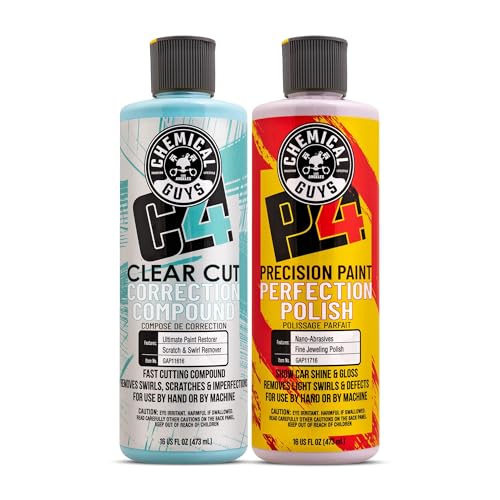
Chemical Guys C4 & P4 Compound & Polish Kit 2 x 16 oz

ABRO Rubbing Compound 10 oz

menzerna Super Finish Plus 3800 Deep Gloss Polish 8 fl oz
More Details On Your Top Picks
Aluminum wheels, stainless trim, brass fittings, and exhaust tips need a metal polish rather than a paint-correction compound. Mothers Mag & Aluminum Polish comes in a 10-ounce container and targets uncoated, unplated metal surfaces, making it a practical choice for garage touch-ups and seasonal vehicle care.
You apply it with a clean cloth, so the setup stays straightforward for hand work around trim and small metal sections. You may find that neglected surfaces need repeated passes and firm rubbing, while the same effort feels unnecessary on lightly dulled parts. Compared with Chemical Guys V36, this option suits bare metal rather than painted clear coat.
Strong Points
- Supports care across aluminum, stainless steel, brass, and other uncoated or unplated metals.
- The 10-ounce size gives you useful supply for recurring trim and wheel maintenance.
- Hand application works well for narrow trim, exhaust outlets, and smaller metal details.
- A focused formula keeps you from using a paint compound on metal surfaces.
- Regular cloth application makes storage and cleanup relatively simple.
Things To Consider
- Hand polishing takes time on heavily neglected metal, especially across large wheels.
- Owners commonly report that residue control matters, so clean cloths and thorough buffing are part of the upkeep.
Key Specs
Who It Suits Best
You’ll get the best fit from this polish for hand-applied aluminum wheel, exhaust, and trim care.
Consider Something Else When
Chemical Guys V36 suits you better for moderate swirls and defects across painted body panels.
Moderate swirls and paint defects call for more correction than a finishing polish, but a heavy-cut compound can be excessive. Chemical Guys V36 uses an optical-grade abrasive approach, meaning its fine cutting particles are intended to refine the paint surface while correcting visible imperfections. The 4-ounce container fits occasional hood, door, or panel work.
For a weekend detailer working on a daily commuter, the extended work time described for V36 may make panel-by-panel correction easier to manage. Its powder-free, dust-free formulation can also reduce cleanup around the work area, though pad choice and machine speed still influence the result. Compared with the stronger V32, V36 is the calmer route for moderate correction.
What You Like
- Targets swirls, scratches, and moderate paint defects in a single correction step.
- Optical-grade abrasives focus on surface clarity rather than leaving a coarse finish.
- The 4-ounce format suits small projects and occasional panel correction.
- Powder-free and dust-free formulation may leave less residue around garage equipment.
Worth Noting
- Its moderate-cut positioning may not address deep sanding marks or severe scratches.
- Small volume can feel limiting across a large SUV or repeated full-vehicle work.
- Machine technique and pad selection remain important for consistent correction.
Feature Snapshot
Made For
This pick fits DIY detailers correcting moderate paint marks on cars and smaller sport utility vehicles.
Where Another Pick Suits Better
menzerna Super Finish Plus 3800 suits you more for final gloss work after heavier correction.
Deep scratches, sanding marks, and pronounced swirls need a more forceful correction compound than V36. Chemical Guys V32 is positioned as an extreme-cut formula with optical-grade micro-abrasives, which are very small abrasive particles designed to level serious surface defects. That makes it relevant for older paint and demanding restoration work.
The 4-ounce single-unit format is easy to store, but it may not stretch far across a full-size vehicle with widespread damage. You may find the aggressive cut creates a follow-up polishing requirement, especially on dark paint where haze shows readily. Compared with ABRO Rubbing Compound, V32 is more specialized for deep paint correction rather than general oxidation cleanup.
Highlights
- Designed for deep scratches, sanding marks, heavy swirls, and severe paint defects.
- Micro-abrasive technology supports fast material removal during correction work.
- Optical-grade positioning helps set up a clearer surface for later polishing.
Trade Offs
- Heavy cutting can require a separate refinement stage for gloss and clarity.
- The 4-ounce quantity may feel modest during extensive restoration projects.
- Less suitable for a quick, light polish on otherwise tidy daily-driver paint.
- Residue and pad cleaning deserve attention after aggressive correction sessions.
Technical Sheet
Right Fit For
You’ll find the strongest match here as an experienced DIY detailer handling deep paint defects with a planned refinement step.
Not Your Match When
ABRO Rubbing Compound fits you better for weathered oxidation, light scuffs, and hand-or-machine cleanup.
A two-step correction routine makes sense for a full vehicle that needs both defect removal and finish refinement. Chemical Guys C4 & P4 pairs a cutting compound with a precision polish, giving you a dedicated first stage for scratches, swirls, oxidation, towel marks, and etching before the gloss-focused second stage. Each bottle holds 16 ounces, so the kit is oriented toward larger projects rather than isolated touch-ups.
For a busy garage, keeping both stages together reduces the guesswork of matching separate formulas. C4 handles the correction work, while P4 refines the surface afterward, although the two-step process takes longer than using a single maintenance polish. Depending on the paint condition, you may need the heavier V32 approach for unusually deep defects.
Upsides
- Combines a cutting compound and finishing polish in one coordinated kit.
- Two 16-ounce bottles provide useful volume for full-car and SUV projects.
- C4 addresses scratches, swirls, oxidation, towel marks, and etching.
- P4 gives you a dedicated refinement stage for added depth and gloss.
- The sequence suits detailers who want a repeatable correction routine.
Minor Gripes
- Two-step correction requires more time, pad changes, and wipe-downs than a one-product session.
- Storage takes more room than the 4-ounce V36 or V32 bottles.
Quick Facts
Who Will Love This
This kit suits detail-focused homeowners and professionals handling complete vehicle paint-correction projects.
Look Elsewhere When
Chemical Guys V36 fits you better for a smaller, moderate-defect job that doesn’t need two 16-ounce stages.
Faded paint and surface oxidation often need more cutting action than a routine finishing polish provides. ABRO Rubbing Compound comes in a 10-ounce size and is designed for oxidized paint, swirl marks, scuffs, light scratches, stains, and paint-transfer marks. Its hand-or-machine flexibility gives you a practical path for a driveway project or a powered buffer session.
That broad use makes ABRO easier to place than V32, though it doesn’t provide the same clearly separated two-stage system as the Chemical Guys C4 and P4 kit. For most older commuter vehicles, the formula may be a sensible first correction step before a finer polish or protective layer. Keep your cloths or pads clean because oxidation residue can build during the work.
Bright Spots
- Targets dull, weathered, and oxidized paint rather than only light surface haze.
- Addresses common marks such as scuffs, swirls, stains, and paint transfer.
- Hand application helps with localized areas and small correction jobs.
- Machine compatibility gives you a faster route across broader panels.
Points To Note
- Its fast-cut focus can leave you needing a finer polish for maximum clarity.
- Large oxidized areas may create substantial residue, increasing pad and cloth maintenance.
- Deep scratches remain outside the practical scope of a general rubbing compound.
Details At A Glance
Best Suited To
You’ll appreciate this option for older vehicles with oxidized paint and a mix of light surface marks.
Another Choice May Suit
Chemical Guys C4 & P4 suits you more for a complete correction-and-refinement routine across an entire vehicle.
Fine micro-scratches and holograms need a finishing polish rather than an aggressive compound. menzerna Super Finish Plus 3800 is an 8-fluid-ounce polish designed for deep gloss work on cars and SUVs, with a focus on a mirror-like finish. Holograms are fine, machine-induced trails that can show under direct light, particularly on dark paint.
Use this as the final refinement stage after a stronger correction product, such as V32 or the C4 compound. Its silicone-free formulation may appeal to detailers who want a clean finishing step before applying a sealant, though the small bottle is better suited to focused finishing than repeated fleet work. In our view, dark-color vehicle owners gain the clearest reason to choose it.
Best Bits
- Focuses on micro-scratches, holograms, and final paint clarity.
- The 8-fluid-ounce size suits repeated finishing on cars and SUVs.
- Designed for a deep gloss appearance after heavier correction.
Room For Improvement
- It lacks the cutting strength needed for deep scratches and heavy oxidation.
- Finishing polish works best after a separate correction stage, adding another step.
- Owners commonly find that pad cleaning and careful residue removal affect the final appearance.
- The 8-fluid-ounce format may be modest for frequent multi-vehicle detailing.
Core Details
Whose Shelf It Belongs On
This polish suits experienced detailers and dark-paint owners focused on the final refinement stage.
Swap It Out When
Chemical Guys V32 fits you better for deep scratches and sanding marks that require stronger initial correction.
How To Choose The Right Auto Polishing Compounds
Match Abrasive Strength to the Defect
A polishing compound uses abrasive particles to level tiny paint irregularities. Light finishing formulas address haze, holograms, and micro-scratches, while cutting compounds remove more material to reduce deeper swirls, sanding marks, and oxidation. Your safest starting point is the least aggressive option that matches the defect, because heavy cutting usually creates a second refinement step.
V36 fits moderate paint correction, menzerna Super Finish Plus 3800 fits final gloss, and V32 belongs with severe defects. ABRO sits closer to general oxidation and surface-mark cleanup, while Mothers is intended for metal rather than painted panels.
Decide Between Hand and Machine Work
Hand application gives you control around badges, narrow trim, wheels, and small blemishes. It also demands more time and physical effort across a hood or roof. Machine polishing covers large panels faster, but pad selection, working speed, and residue removal matter more.
ABRO supports hand or machine use, while Mothers makes the most sense for cloth-based metal care. The Chemical Guys correction options suit a machine-centered workflow more naturally, especially across a whole vehicle.
Think About Your Finish Sequence
A compound removes defects, but the resulting surface may still need a finer polish. Two-step kits such as C4 and P4 simplify that sequence by pairing correction with refinement. A single bottle can be more convenient for small jobs, yet a dedicated finishing stage gives you greater control over the final clarity.
Dark paint makes leftover haze and holograms easier to notice, so menzerna Super Finish Plus 3800 earns more value as a final step after V32 or C4.
Account for Quantity and Storage
A 4-ounce bottle fits occasional panel work and takes little shelf space. Larger 16-ounce bottles make more sense for complete vehicles, multiple cars, or recurring detailing sessions. Store compounds upright, keep caps clean, and close containers promptly to reduce residue around the neck and preserve easy dispensing.
Things Worth Knowing First
Mistakes Worth Dodging
Choosing a heavy-cut compound for light haze can create unnecessary correction work. Start by identifying the surface: Mothers belongs on uncoated metal, while V36, V32, C4, P4, ABRO, and menzerna target painted exterior care.
A small bottle can also disappoint during a full SUV project. Match the container size to the number of panels and the frequency of your detailing routine.
What Separates Premium From Basic
Higher-tier formulas often focus more narrowly on abrasive behavior, work time, residue control, or the transition from cutting to finishing. That extra refinement matters most for dark paint, machine polishing, and correction work under strong lighting.
Basic rubbing compounds remain sensible for oxidation, scuffs, and localized marks. Spending more makes sense once you need controlled correction, a coordinated two-step process, or a cleaner final finish.
Final Verdict
Your best match depends on the surface and the defect depth. Mothers Mag & Aluminum Polish handles bare metal, ABRO covers practical oxidation cleanup, and Chemical Guys V36 suits moderate paint correction. V32 gives experienced detailers stronger cutting action, while the C4 and P4 kit organizes a full two-step project. menzerna Super Finish Plus 3800 belongs at the finishing stage, especially across dark paint. Choose the mildest formula that fits your correction goal, then reserve heavier compounds for defects that genuinely need them.
