

Small paint damage can make a well-kept vehicle look tired, especially around door edges, wheels, bumpers, and high-contact panels. You need the right type of correction for the mark: a polishing compound suits surface-level swirls, while touch-up paint makes more sense for a visible chip or exposed spot.
This roundup covers five options for driveway detailers, daily commuters, and anyone handling minor cosmetic damage at home. You’ll find simple hand-applied choices, two-stage correction formulas, and heavier compounds for machine-assisted work.
The Shortlist At A Glance

Carfidant Scratch and Swirl Remover with Pad and Towel
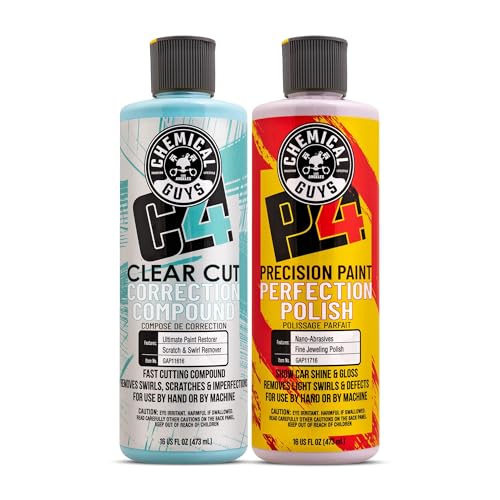
Chemical Guys C4 and P4 Compound and Polish Kit

UBOG Touch Up Paint Pen for Cars (Black)

SENVEN Black Paint Touch Up Pen for Cars and Rims

menzerna Heavy Cut Compound 1000, 8 fl oz
More Details On Our Top Picks
Light swirls from automatic washes and shallow surface marks call for a polishing compound rather than a paint pen. Carfidant pairs that type of formula with a buffer pad and towel, giving you a compact setup for driveway touch-ups without adding a machine polisher.
For daily commuters, the hand-oriented format keeps the task approachable around door handles, trunk lids, and other visible panels. You may find the result depends heavily on scratch depth and preparation, so this suits cosmetic surface correction more than damage that catches firmly on a fingernail.
Strong Points
- The included pad and towel reduce the need to assemble a separate hand-polishing kit.
- Its focus on scratches and swirls suits routine paint care after frequent washing.
- Hand application gives beginners better control on small sections than a powered tool.
- The compact format stores easily with wash supplies in a garage cabinet.
- The polishing and waxing kit category makes its intended exterior use clear.
Things To Consider
- Surface-level correction is the sensible expectation, while pronounced gouges may remain visible.
- Owners commonly find that residue is easier to manage with small working sections and a clean towel.
Key Specs
Who It Suits Best
You’ll get the clearest fit as a beginner handling light swirls and shallow marks by hand.
Consider Something Else When
Choose UBOG Touch Up Paint Pen for Cars (Black) for a small chip or paint-colored spot that needs pigment rather than surface polishing.
Paint correction often works better as two separate stages: a compound levels visible defects, then a polish refines the finish. Chemical Guys builds that sequence into one kit with C4 for heavier correction and P4 for the gloss-focused step afterward.
The two 16-ounce bottles make more sense for a full vehicle or repeated detailing than for a single tiny mark. Compared with Carfidant’s pad-and-towel simplicity, this setup gives you a more deliberate workflow, though you’ll need extra application equipment and more time between stages.
What We Like
- The separate compound and polish divide correction from finish refinement.
- Two 16-ounce containers provide useful volume for multiple panels.
- C4 addresses scratches, swirls, oxidation, towel marks, and etching according to the supplied product information.
- P4 gives you a dedicated follow-up stage for paint clarity and gloss.
Trade Offs
- The two-step process asks for more patience and cleanup than a single hand-applied formula.
- Machine work generally requires suitable pads and a compatible polisher, which adds setup considerations.
- Storage takes more room than the compact Carfidant kit.
Feature Snapshot
Made For
You’ll appreciate this kit most as a confident DIY detailer correcting several panels and chasing a more refined finish.
Not Your Match When
SENVEN Black Paint Touch Up Pen for Cars and Rims suits you better for quick black marks on wheels, bumpers, or isolated body spots.
A paint pen addresses a different problem from Carfidant and Chemical Guys: it adds matching color to a small blemish instead of smoothing the surrounding clear coat. UBOG’s black version is aimed at tiny chips and scratches on black-painted areas, with a pen format that fits easily into a glove compartment.
That narrow application can be useful after a parking-lot scrape or a wheel-edge scuff. You’ll want careful surface cleaning and restrained application, because a touch-up pen can look raised or mismatched across a large area; the honest read is that it’s a spot-repair tool, not a panel refinishing system.
Highlights
- Black paint targets a common vehicle color and keeps the product focused.
- The pen format supports precise work on small chips and isolated marks.
- Its small footprint makes glovebox or detailing-bag storage straightforward.
Minor Gripes
- Color matching can vary across different black finishes and paint ages.
- Owners commonly report that the tip needs careful cleaning and secure storage to avoid drying between uses.
- Larger scratches may show an uneven edge after spot application.
- The supplied information identifies a single touch-up pen, so you shouldn’t expect a broader accessory kit.
Quick Facts
Right Fit For
You’ll find the best use case in small black chips, edge marks, and isolated cosmetic damage on a personal vehicle.
Look Elsewhere When
menzerna Heavy Cut Compound 1000, 8 fl oz fits you better for broad correction of sanding marks, swirls, and other paint-surface defects.
Wheel scuffs need a slightly different kind of convenience because damage often appears on rims, bumpers, and lower bodywork rather than broad painted panels. SENVEN uses a high-gloss black touch-up format and is described for vehicle bodies, wheels, bumpers, motorcycles, yachts, and furniture with bright surfaces.
The 30ML container gives you more material than a tiny spot pen, while the supplied information also identifies a 1.5-ounce quantity. For most home garages, that broader application range is useful, though finish matching remains the deciding factor across different gloss levels and materials.
Upsides
- Black high-gloss paint suits many wheel and trim touch-ups.
- The stated multi-surface use expands its role beyond vehicle body panels.
- 30ML and 1.5-ounce size details indicate more coverage than a very small pen format.
- Quick-drying positioning can help you finish minor repairs without a long waiting period.
- The brush-head design is intended for controlled coverage on narrow scratches.
Points To Note
- High-gloss black may stand out against satin, textured, or faded surfaces.
- Preparation and thin coats matter on rims, where brake dust and road grime can affect adhesion.
At A Glance
Who Will Love This
You’ll find this most useful for black wheels, bumpers, and assorted glossy vehicle surfaces that collect small chips and scuffs.
A Better Fit Elsewhere
UBOG Touch Up Paint Pen for Cars (Black) is a tidier fit for you when the job involves one or two very small black paint marks and minimal storage space.
Deep scratches, sanding marks, swirls, and holograms require more correction than a small touch-up pen can provide. menzerna Heavy Cut Compound 1000 uses an abrasive polishing compound approach, giving experienced detailers a heavier-cut option for working across damaged paint.
Machine polishers, including orbital or rotary tools, are the natural match, while hand application remains available for smaller jobs. Compared with Chemical Guys C4 and P4, this choice concentrates on aggressive correction rather than supplying a separate finishing polish, so you’ll need a follow-up step for the cleanest final appearance.
Bright Spots
- The heavy-cut positioning suits deeper surface defects and sanding marks.
- Compatibility with orbital and rotary polishing machines supports experienced detailing workflows.
- Hand application remains possible for isolated correction work.
- Silicone-free formulation suits detailers who prefer that specification in a polishing compound.
Room For Improvement
- Heavier correction demands more control than a beginner-friendly hand polish.
- Owners commonly report that compound residue calls for thorough panel cleanup before the finishing stage.
- The 8-fluid-ounce size is less suited to repeated full-vehicle work than Chemical Guys’ two-bottle, 16-ounce format.
Core Details
Built With In Mind
You’re the right match as an experienced detailer with a machine polisher and a clear plan for follow-up finishing.
Swap It Out When
Chemical Guys C4 and P4 Compound and Polish Kit suits you more when you want correction and finish refinement packaged as a coordinated two-stage process.
How To Choose The Right Auto Paint Scratch Repairs
Match the Formula to the Damage
Start by identifying whether the mark sits on the surface or removes visible paint. Polishing compounds work by refining or leveling the surrounding finish, making them appropriate for swirls, towel marks, oxidation, and some shallow scratches. Touch-up paint adds color to a chip or narrow gouge, so it suits isolated damage where polishing alone won’t restore the appearance.
A fingernail-catching scratch generally deserves more caution than a faint wash mark. You may find a pen leaves a raised spot on broad damage, while a heavy compound can be excessive for a tiny chip.
Choose Hand Work or Machine Correction
Hand application gives you control and keeps the setup manageable for a weekend driveway session. Carfidant includes a pad and towel, which makes that route accessible for small sections. Touch-up pens take even less equipment, but their precision depends on your application technique and color match.
Machine polishing offers greater correction potential, particularly with menzerna Heavy Cut Compound 1000. An orbital polisher spreads movement across the pad, while a rotary polisher spins from a fixed axis and demands more experience, so machine-oriented compounds fit confident detailers rather than first-time users.
Consider the Finish You Want
A compound removes or reduces defects, but it can leave a finish that needs refinement. Chemical Guys separates those jobs into C4 and P4, giving you a correction stage followed by a dedicated polish. That arrangement makes sense across multiple panels where clarity and gloss matter as much as scratch reduction.
Touch-up paint follows a different path. Black UBOG and SENVEN pens are practical for color coverage, yet their finish must match the surrounding panel. Gloss level, paint age, panel condition, and application thickness all affect how discreet the repair appears.
Factor in Storage and Maintenance
A pen belongs in a small detailing pouch and needs a secure cap after use. Compounds require clean pads, suitable towels, and careful residue removal, especially across a full vehicle. Larger kits offer more flexibility, though they occupy more shelf space and create more cleanup.
For occasional driveway care, a compact hand kit may be enough. Frequent detailers benefit from larger containers, staged formulas, and compatibility with machine pads, provided the extra equipment already fits your garage routine.
Things Worth Knowing First
Mistakes Worth Dodging
Choosing a compound for a paint chip often leaves you with the wrong tool, while applying touch-up paint to broad swirls can create visible spots. Clean and dry the panel first, work on a small area, and keep the repair matched to the damage type.
Color names also deserve attention. Black paint varies across manufacturers, gloss levels, and vehicle ages, so a black pen may blend more naturally on one panel than another. Thin, controlled application usually gives you more room to refine the finish.
What Separates Premium From Basic
Higher-tier correction kits tend to cost more because they separate abrasive cutting from final polishing, provide larger quantities, or support machine-assisted workflows. Chemical Guys C4 and P4 illustrates the staged approach, while menzerna Heavy Cut Compound 1000 focuses its formulation around heavier correction.
That extra capability matters for multi-panel work, repeated detailing, and experienced hands. A compact pen or hand kit remains the more sensible choice for one small mark, where additional bottles and tools add clutter rather than useful control.
Closing Remarks
You’ll get the best result by matching the repair method to the damage, not by choosing the most elaborate format. Carfidant suits light surface marks, Chemical Guys gives you a two-stage correction path, and menzerna serves more demanding machine-assisted work. UBOG and SENVEN make sense for focused black paint touch-ups, with SENVEN extending to wheels and other glossy surfaces. Prepare the panel carefully, work in small sections, and choose the option that fits your skill level and garage routine.
