

A quality spray setup can turn a rough garage repaint into a more controlled project, but the right combination depends on your coating, compressor, repair size, and cleanup tolerance. You’ll find single-gun kits for everyday refinishing, two-gun systems for primer and topcoat work, and specialized options for polishing or satin urethane finishes. This roundup helps you match each item to real jobs, from spot repairs and furniture projects to full exterior panels. You’ll also see where nozzle size, cup design, cordless power, and coating compatibility affect ownership.
The Shortlist At A Glance

StartingLine HVLP Automotive Spray Painting Kit 802342

StartingLine HVLP Auto Painting and Priming Kit 802343
Hotorda HVLP Spray Gun Kit 600cc

Niusken Cordless Car Buffer Polisher 21V Yellow

3M Performance Spray Gun Starter Kit 26778
Speedokote SMR-207/211 Hot Rod Black Paint
More Details On Your Top Picks
For a garage repair that needs both panel coverage and smaller touch-up work, this DeVilbiss setup gives you two spray formats rather than forcing one gun to handle every task. The 1.3 mm fluid tip suits base and clear coatings, while the smaller 1.0 mm arrangement is better matched to localized repairs. Depending on your compressor and coating thickness, you may find the focused gun easier to control around edges and repaired sections.
The aluminum and plastic cups keep the kit adaptable, and the regulator with gauge gives you a visible pressure reference during setup. A carrying case, cleaning brushes, and maintenance wrench help keep the tools together after a busy garage session. The honest trade-off is that you’ll need disciplined cleaning between coatings, especially around the fluid tip and needle.
Strong Points
- Two tip-and-cup combinations cover broad panels and spot repairs.
- The pressure gauge helps you make repeatable air adjustments.
- Included cleaning tools reduce the need to assemble a separate maintenance kit.
- The case makes storage more practical in a crowded workshop.
Things To Consider
- Changing between coating types adds cleaning and setup time.
- You’ll need suitable compressor capacity and careful viscosity adjustment for consistent atomization.
Key Specs
Who It Suits Best
You’ll get the most from this kit for occasional automotive refinishing, detail work, and home-garage projects requiring two spray scales.
Consider Something Else When
Choose the StartingLine HVLP Auto Painting and Priming Kit 802343 for regular projects that need separate primer and finish guns.
Primer and finish coats behave differently, so a dedicated gun for each stage can make a home repaint less tedious. This DeVilbiss kit builds around that distinction with a full-size finish gun and a separate priming gun, giving you a cleaner workflow than the single-gun 802342. You may find that separation especially useful across several panels, where repeated flushing can interrupt your rhythm.
The finish setup uses a 1.3 mm fluid tip and a 600cc metal cup, a combination aimed at lighter-viscosity topcoats. The priming gun adds capacity for thicker undercoating work, while the accessory package supports routine adjustments and cleanup. Storage takes more room than a one-gun kit, and you’ll need clear labeling so leftover primer doesn’t end up in the finish gun.
What We Like
- Two full-size guns separate primer work from basecoat and clearcoat application.
- The metal cup suits larger finish-coat sessions.
- A dedicated setup can reduce coating changes during multi-panel projects.
Trade Offs
- Two guns mean more parts to clean, store, and maintain.
- Beginners still need to learn pressure, overlap, and coating-thickness control.
- A suitable compressor and workspace remain essential for steady spraying.
Feature Snapshot
Made For
You’re well matched with this kit for DIY vehicle refinishing that includes both primer application and finish coats.
Not Your Match When
The Hotorda HVLP Spray Gun Kit 600cc fits you better for lower-complexity furniture, wall, and craft projects using one adaptable gun.
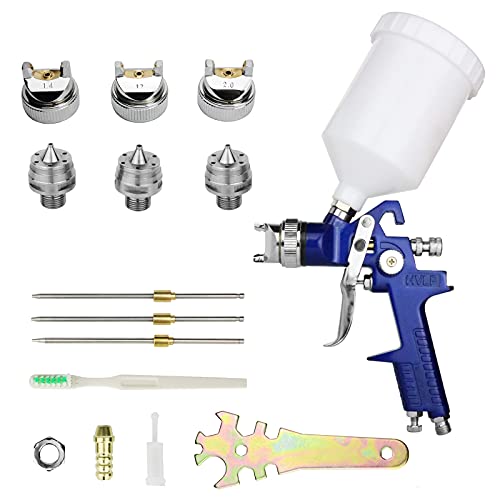
Three replaceable nozzle and needle sizes give you a useful range for primer, base coatings, furniture, walls, and automotive surfaces. The 1.4 mm, 1.7 mm, and 2.0 mm options let you adjust the spray format to the material rather than relying on a single opening. For most small workshop projects, that flexibility matters more than a large accessory bundle.
The 600cc cup supports a reasonable work session, though its size can feel excessive for a tiny touch-up and limiting for a large vehicle side. Compared with the DeVilbiss kits, this Hotorda option is a simpler single-gun route, so you’ll spend more time cleaning between primer and finish materials. You may find it a sensible starting point for varied household projects, provided you’re prepared to tune the gun with your chosen coating.
Upsides
- Three nozzle sizes broaden its use across thinner and heavier coatings.
- The 600cc cup supports furniture panels and automotive sections without constant refilling.
Room For Improvement
- One gun requires thorough cleaning between incompatible materials.
- Setup and spray-pattern adjustment can take patience for first-time users.
- The listing provides limited detail about included maintenance accessories.
At A Glance
Right Fit For
You’ll find this option most suitable for beginners handling mixed automotive, furniture, wall, and craft spraying tasks.
Look Elsewhere When
Pick the 3M Performance Spray Gun Starter Kit 26778 for frequent finish work that benefits from replaceable atomizing heads and a disposable cup system.
Paint application isn’t the only part of exterior refinishing. This Niusken cordless dual-action polisher uses a random orbital motion, meaning the pad travels in an offset path rather than spinning on one fixed axis. That format suits wax application, surface polishing, and detailing around a driveway where an air hose would be inconvenient.
You get two 21V, 2000mAh batteries, six speed settings, an LED display, and 18 assorted pads. The cordless layout improves movement around a vehicle, although the battery system doesn’t work with DeWalt batteries, so you’ll be maintaining a separate power platform. Depending on panel size and compound choice, you may need to plan charging and pad changes around the job.
Highlights
- Cordless operation keeps you clear of extension cords and air hoses.
- Six speed levels help you select a gentler or more active polishing pace.
- The display makes the selected setting easier to monitor.
- Two batteries support longer detailing sessions than a single pack.
- The assorted pads cover several polishing and application tasks.
Points To Note
- The proprietary battery format adds storage and replacement considerations.
- Pad cleaning and compound removal remain hands-on maintenance tasks.
Quick Facts
Who Will Love This
You’ll appreciate this polisher for mobile detailing, driveway maintenance, and users who value cordless movement over spray-gun capability.
A Better Fit Elsewhere
Choose the Speedokote SMR-207/211 Hot Rod Black Paint for a dedicated satin black coating project rather than surface polishing.
Frequent finish work rewards a system that reduces cup handling and keeps atomization consistent. The 3M kit pairs a spray gun with PPS 2.0 disposable liners, filtered lids, sealing plugs, and an airflow control valve, so you can focus on the panel instead of repeatedly scrubbing a rigid cup. Its 15 replacement heads, supplied across 1.2 mm, 1.3 mm, and 1.4 mm sizes, give you more control over coating selection than the fixed arrangements in the StartingLine kits.
For a busy paint area, disposable liners can simplify changeovers and reduce solvent-heavy cleanup, though they add consumable management to your routine. The system suits repeated professional-style work, but the specialized cup and head format may feel excessive for one small repair. You may find the higher setup complexity worthwhile across regular projects, especially where predictable preparation matters.
Bright Spots
- Multiple atomizing-head sizes support different coating applications.
- Disposable liners can shorten cleanup between color or material changes.
- Filtered lids help manage material flow through the cup system.
- The airflow valve gives you an additional adjustment point.
Small Caveats
- Consumable liners and lids create an ongoing supply requirement.
- The PPS format has a learning curve for users accustomed to conventional cups.
- Storage is less compact than a basic single-gun kit.
Feature Card
Best Suited To
You’re best matched with this kit for frequent refinishing, production-minded garage work, and users comfortable managing replacement liners and heads.
Swap It Out When
The StartingLine HVLP Automotive Spray Painting Kit 802342 suits you better for occasional repairs requiring a detail gun and a conventional cup setup.
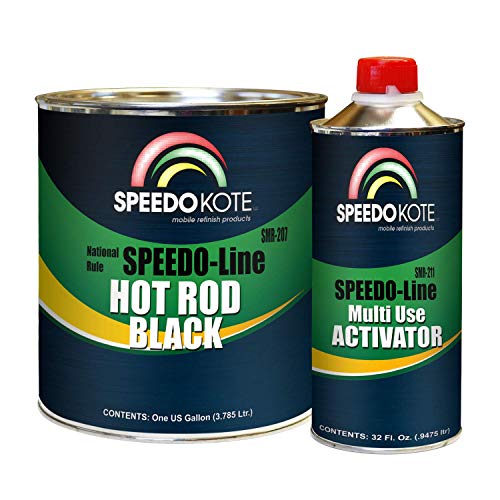
Spray equipment only solves half the refinishing job, and this Speedokote kit addresses the coating side with a satin black two-component urethane system. You mix the SMR-207 coating with its activator at a 4:1 ratio, creating a single-stage finish intended for a uniform black exterior result. Compared with the spray guns above, this item makes sense as a material choice for a defined style rather than a general-purpose tool kit.
The formula is described as resistant to ultraviolet exposure, chemicals, and rubbing, which suits exterior vehicle panels and hot-rod projects that need a consistent satin appearance. Regional restrictions matter: the listed SMR-207 version isn’t intended for areas with a 2.8 lbs-per-gallon VOC limit, and the listing points California, Delaware, and Maryland shoppers toward SMR-456. You’ll also need accurate mixing, suitable ventilation, and careful cleanup, so this coating is less forgiving than a simple ready-to-use paint.
Reasons To Buy
- The two-part urethane format is designed for a durable exterior coating.
- Satin black gives you a consistent Hot Rod Black appearance.
- Ultraviolet, chemical, and rubbing resistance support exterior vehicle use.
- The gallon coating and included activator support larger refinishing projects.
Honest Caveats
- The 4:1 mixing ratio requires accurate measuring and careful preparation.
- Regional VOC rules can affect whether this specific version suits your location.
- Cleanup and storage demand attention after the activated coating is mixed.
Core Details
Whose Shelf It Belongs On
You’ll suit this coating best for experienced DIY refinishers and custom-vehicle projects needing a satin black exterior finish.
Reach For A Different Pick When
Select the 3M Performance Spray Gun Starter Kit 26778 for a reusable spray system rather than a dedicated satin-black coating.
How To Choose The Right Auto Paint Kits
Match The Gun To The Coating
A fluid tip is the opening that meters coating toward the air stream. Smaller sizes generally suit thinner finish materials and detail work, while larger openings accommodate heavier primers, but your coating instructions and compressor setup still control the final result. The 802342 gives you 1.0 mm and 1.3 mm options, while the Hotorda adds 1.4 mm, 1.7 mm, and 2.0 mm choices.
Decide Between One or Two Guns
A single gun keeps storage and maintenance simpler, making the 802342 useful for occasional repairs. Two guns, as found in the 802343, let you keep primer separate from finish material, which saves repeated flushing across a multi-stage repaint. You’ll trade compact storage for a smoother workflow.
Consider Cup and Cleanup Demands
Cup capacity affects how often you stop to refill, not the quality of the finish by itself. A 600cc cup suits panels and moderate batches, while the 3M PPS 2.0 approach uses disposable liners to simplify material changes. You’ll still need a cleaning routine for the nozzle, needle, air cap, and surrounding passages.
Separate Paint Application From Correction
A spray gun applies material, while a dual-action polisher corrects or refines an existing finish. The Niusken belongs in the second category, so it complements rather than replaces a gun. For a full project, you may need both application equipment and a polishing step after curing, depending on the finish and surface condition.
Things Worth Knowing First
Mistakes Worth Dodging
Choosing a nozzle by size alone can create frustration. Match the opening to the coating instructions, then account for compressor output, spray distance, overlap, and viscosity. You’ll also want enough protected workspace for overspray, plus a cleaning plan before material begins to set inside the gun.
Regional compliance deserves attention with specialized coatings. Speedokote’s listed SMR-207 version has a stated VOC figure and location restrictions, so check the applicable local requirements before selecting that formulation.
Where The Extra Money Goes
Higher-tier spray systems often charge more for replaceable heads, airflow control, disposable cup components, and a larger supply of consumables. Those details matter most in repeated work, where faster changeovers and consistent setup can offset added complexity. For one small repair, a conventional kit may make more sense.
The 3M kit suits a regular paint area, while the DeVilbiss options keep the format more familiar. You’re paying for workflow control rather than a guarantee of a better result, since preparation and technique still shape the finish.
Final Verdict
You can narrow this list by matching the equipment to the job: choose the DeVilbiss 802342 for flexible detail and finish spraying, the 802343 for separate primer and topcoat work, or Hotorda for varied household projects. The 3M kit fits repeated refinishing with a more organized cup system, while Speedokote supplies a defined satin black coating. Niusken belongs in the polishing stage, especially where cordless movement matters. Start with coating compatibility, compressor demands, cleanup, and local rules, then choose the setup that fits your workspace.
