

Dead batteries have a way of showing up on cold mornings, busy weekends, and the one day you really need the vehicle to cooperate. The right charger saves you from guesswork, especially when you keep a truck, mower, boat, or older car ready to go. This roundup focuses on models that fit different garage habits, from simple maintenance to heavier recovery work. You’ll also see where each unit makes sense, and where a lighter or more specialized pick may be the better fit.
Quick Look At Our Shortlist

Schumacher Electric Wheeled 10A Car Battery Charger SC1446

Schumacher Electric Wheeled 6A Car Battery Charger SC1364

CRAFTSMAN 12A Car Battery Charger CMXCESM258

DeWalt DXAEC100 30 Amp Battery Charger

12-Amp Smart Battery Charger 12V/24V

PCHH 12V 24V Car Battery Charger Heavy Duty

PZ.P 15-Amp 12V/24V Smart Battery Charger
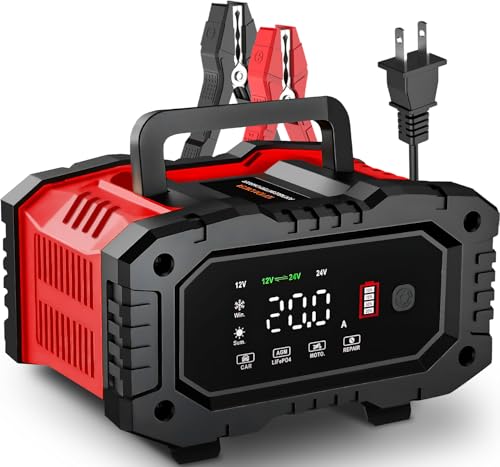
20-Amp Car Battery Charger 12V/24V
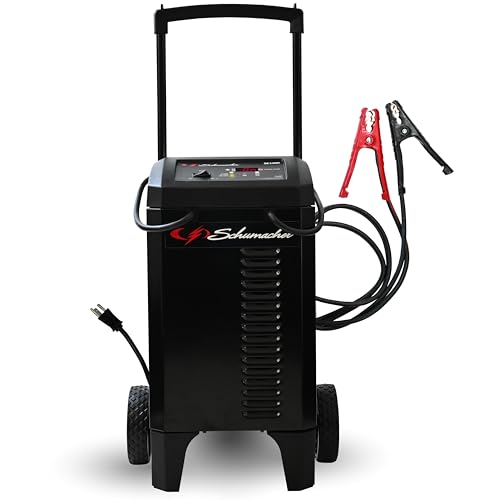
Schumacher Electric Wheeled 6A Car Battery Charger SC1400
More Details On Our Top Picks
The SC1446 makes sense for garages where control matters more than polish. Its wheeled frame keeps it mobile, and the manual style suits older vehicles, tractors, and the kind of dead battery that can confuse more automated units.
That extra hands-on approach is also the trade-off, since you give up the comfort of a fully automatic routine. For drivers who keep a weekend car, a shop truck, or equipment battery in rotation, that flexibility can be the point rather than the drawback.
Strong Points
- Wheeled design makes it easier to move around a garage or farm bay.
- Manual control gives you more say over how the charging process is handled.
- Better suited to older batteries that some smart units may not recognize.
- The setup fits hands-on owners who like direct control over charging steps.
Points To Note
- The manual style asks for more attention than a fully automatic unit.
- Its larger footprint is less convenient for tight storage shelves.
- Owners who want set-it-and-forget-it operation may prefer a simpler smart model.
Feature Snapshot
Who It Suits Best
You get the most from this model in a garage, workshop, or farm setup where a battery charger needs to stay close to older equipment and repair work.
Where A Sibling Pick Shines
Schumacher Electric Wheeled 6A Car Battery Charger SC1364 suits you better for lighter maintenance jobs and slower, simpler upkeep on a vehicle that sits for long stretches.
The SC1364 is the quieter, slower sibling in this Schumacher pair, and that’s part of its appeal. A 6-amp charger is a better fit for maintenance-minded owners than for anyone chasing fast recovery, especially in a garage where batteries sit for long stretches.
You may find the pace reassuring rather than frustrating, because trickle-style upkeep usually asks for patience, not drama. The wheeled body keeps it practical, while the simpler output profile makes it easier to live with for routine use.
What We Like
- Six amps is a comfortable pace for regular maintenance and long-term upkeep.
- The wheeled design helps it move cleanly around a garage floor.
- It fits owners who want a straightforward charger without extra complexity.
- Lower output can be easier on batteries that only need gentle care.
Minor Gripes
- It is slower than higher-output options in this roundup.
- Drivers needing fast recovery will likely want more charging muscle.
- The form factor is practical, but not especially compact for tight closets.
Details At A Glance
Who Should Grab It
You get the best fit here for routine battery upkeep, weekend cars, and storage situations where charging speed matters less than steady care.
Another Choice May Suit
DeWalt DXAEC100 30 Amp Battery Charger works better for you when faster charging and engine-start support matter more than gradual maintenance.
The CRAFTSMAN CMXCESM258 sits in a very useful middle ground, with enough output for everyday garage work and enough charging flexibility to cover more than one battery type. Unlike the slower Schumacher SC1364, this one is built for owners who want a little more pace without moving into heavy-duty territory.
Its automatic voltage detection keeps the process calmer for mixed-use garages, where a car battery one day and a smaller 6V setup the next can create confusion. For most home setups, that kind of adaptability is the real value, even before you think about charge speed.
Upsides
- 12-amp output gives it more pace than the 6-amp Schumacher option.
- Works with 6V and 12V batteries, which helps in mixed garages.
- Automatic sensing reduces the guesswork during routine charging.
- Useful for owners who keep several battery-powered machines on hand.
Small Caveats
- It is less forceful than the larger DeWalt and the higher-output Huiaipaic models.
- Owners looking for heavy engine-start support will want a different class of unit.
Core Details
Made For
You should look at this one for mixed household garages, small workshops, and owners who want a single charger that handles more than one battery voltage.
Look Elsewhere When
Huiaipaic 20-Amp Car Battery Charger 12V/24V fits you better if higher output and broader voltage coverage matter more than a balanced middle setting.
The DeWalt DXAEC100 is the kind of charger that suits a busier garage, where battery maintenance and jump-start support need to live in the same box. Its 30-amp charging output puts it well above the gentler upkeep models in this list, and the 100-amp engine-start function adds real utility for vehicles that don’t always cooperate.
The alternator check is a useful extra for diagnosing charging-system trouble, though it does ask for a little more attention than basic chargers. For truck owners, workshop users, and anyone who keeps a vehicle in regular rotation, that extra toolkit can feel worth the bulk.
Highlights
- 30-amp charging suits faster recovery than the lighter maintenance models.
- Engine-start support adds value for stubborn vehicles that need a stronger push.
- Alternator check gives you more information about the vehicle’s charging system.
- Its 3-amp maintain mode helps keep batteries ready between uses.
- Well matched to homes with trucks, project vehicles, or frequent battery turnover.
Areas To Watch
- More capability usually means a larger, more involved unit to store.
- Owners who only need slow maintenance may not use all of its functions.
Feature Rundown
Best Suited To
You get the best match here for serious garage use, project vehicles, and drivers who want one charger that can handle both charging and starting duties.
Skip It When
Schumacher Electric Wheeled 6A Car Battery Charger SC1364 is the softer fit for you when routine upkeep matters more than strong recovery power.
This Huiaipaic charger leans into versatility, with support for lithium and lead-acid battery families in one unit. That matters in a mixed garage, because one charger that can handle a motorcycle, a boat battery, and a lawn machine saves you from keeping separate tools on the shelf.
Its 12V and 24V output coverage also gives it more range than basic single-voltage models. The trade-off is straightforward, though, because a broader feature set usually asks you to read the settings with more care than a simpler maintainer.
Positives
- Works across lithium and common lead-acid battery types.
- 12V and 24V coverage gives it broad garage usefulness.
- The maintainer mode suits seasonal equipment that sits for long stretches.
- Helpful for homes with motorcycles, boats, and lawn gear in the same storage area.
- Its repair-oriented modes add flexibility for batteries that need more than basic topping up.
Worth Noting
- More modes can mean more attention during setup.
- Owners who only need a simple top-off may not use the full feature spread.
- The broad chemistry support is useful, but it also makes the learning curve a touch steeper.
Technical Sheet
Right Fit For
You should look here for a mixed garage that includes powersports, marine gear, and seasonal tools, especially where different battery chemistries share the same storage space.
A Better Fit Elsewhere
CRAFTSMAN 12A Car Battery Charger CMXCESM258 is simpler to live with for you if you want a broad but more straightforward charger for everyday household use.
The PCHH unit feels built for owners who want a sturdier charger without jumping to a full recovery machine. Its copper-coil interior and metal-plus-ABS body point to a tougher build than many lightweight maintainers, which is handy in a workshop or shed where gear gets moved around.
It also covers both 12V and 24V batteries, so it can serve a truck, motorcycle, mower, or boat without needing a separate charger for each one. The honest read is that the weight and size fit a permanent spot better than a small storage drawer.
Bright Spots
- Heavy-duty construction should suit workshop and garage storage well.
- Automatic charging takes some of the guesswork out of upkeep.
- 0 to 15 amp range gives you room for both slower and stronger charging.
- 12V and 24V coverage makes it useful across several vehicle types.
Room For Improvement
- The heavier build is less friendly for frequent carrying.
- Owners with limited shelf space may want a smaller unit.
- It suits a fixed garage spot better than a travel kit.
Core Details
Whose Shelf It Belongs On
You get the most out of this charger in a garage or shed where a heavier-duty, mostly stationary tool makes more sense than a compact carry-along.
Reach For A Different Pick When
Schumacher Electric Wheeled 6A Car Battery Charger SC1364 is the gentler fit for you if simplicity and light upkeep matter more than a heavier, more involved unit.
The PZ.P charger stands out for owners who want a more thoughtful charging sequence without stepping into a much bulkier unit. Its nine-stage process is the kind of detail that matters most for batteries you use across seasons, because a staged routine tends to be gentler than a blunt one-step approach.
Temp compensation is another useful touch, since garages and sheds rarely stay at the same temperature year-round. Compared with the simpler CRAFTSMAN and Schumacher units, this one feels aimed at people who keep several battery types on hand and want a charger that works a little smarter.
Best Bits
- Nine-stage charging gives it a more layered routine than basic units.
- Temp compensation helps it fit changing garage conditions more comfortably.
- Works with LiFePO4 and lead-acid batteries.
- Useful for cars, motorcycles, lawn gear, and boat batteries.
- Its maintainer role supports batteries that sit unused between outings.
Honest Caveats
- The more advanced logic can take a little more reading up front.
- Owners who only need a basic top-up may not use every mode.
At A Glance
Who Will Love This
You should look here for a mixed garage, seasonal vehicle storage, and battery upkeep where a more refined charging sequence matters.
Swap It Out When
Schumacher Electric Wheeled 10A Car Battery Charger SC1446 is a better fit for you if hands-on recovery and older battery handling matter more than smart staging.
This Huiaipaic model is built for owners who want more charging speed without leaving smart maintenance behind. The 20-amp 12V output and 10-amp 24V output put it above the midrange picks in this list, so it suits fuller garages where batteries need a faster turnaround.
Its desulfator function and broader chemistry support make it especially handy for mixed fleets of cars, trucks, tractors, and leisure equipment. The trade-off is that a charger with this much range often works best for people who are comfortable matching the mode to the battery rather than just plugging in and walking away.
Reasons To Buy
- Higher output than the 12-amp and 15-amp choices in this roundup.
- Supports both LiFePO4 and common lead-acid families.
- Smart maintainer behavior suits long-term storage.
- Useful for larger garages with vehicles and equipment in rotation.
- Desulfator support adds another layer of battery care.
Points To Note
- More output usually means more attention to setup and placement.
- Its feature set may be more than occasional users need.
Quick Facts
The Right Fit
You should put this on your shortlist for a busy garage, larger vehicle collection, or equipment shed where faster charging and wider support both matter.
Another Choice May Suit
CRAFTSMAN 12A Car Battery Charger CMXCESM258 is the calmer choice for you if you want a simpler middle-ground charger for everyday use.
The SC1400 brings together a wheeled body, automatic operation, and broader 4-in-1 utility, so it feels closer to a workshop helper than a basic maintainer. Its higher start capability gives it more range than the 6-amp SC1364, which makes it the more serious Schumacher option for garages and farm use.
That extra capacity is useful when you keep equipment batteries, vehicle batteries, and seasonal machines in the same rotation. The flip side is that its size and feature count make it more of a dedicated shop tool than a casual shelf charger.
Standout Traits
- Wheeled design makes movement around larger work areas easier.
- Automatic operation keeps the process more convenient than manual chargers.
- 4-in-1 behavior suits starting, charging, maintaining, and reconditioning tasks.
- Higher start capacity broadens its usefulness for stubborn batteries.
Softer Spots
- Its larger footprint is better for a shop than a tiny storage corner.
- Casual users may not need the full spread of functions.
Feature Card
Built With In Mind
You get the best fit here for a garage, workshop, or farm setup where a larger, more capable charger can stay in one place and handle several jobs.
Where Shoppers Go Wrong
Schumacher Electric Wheeled 10A Car Battery Charger SC1446 is the better match for you if you want manual control and a more hands-on recovery tool instead of an automatic all-rounder.
How To Choose The Right Battery Chargers
Match Output To The Job
Charging amperage, or amps, tells you how quickly a charger can push energy back into a battery. Lower outputs suit maintenance and storage, while stronger outputs make more sense for vehicles that sit dead longer or need a faster turnaround.
A 6-amp maintainer feels right for a weekend car or seasonal mower. A 15-amp or 20-amp unit belongs in a busier garage where you want more speed without jumping straight to a jump-start machine.
Check Voltage And Battery Type
Most garage setups revolve around 12V batteries, but trucks, older equipment, and some mixed fleets call for 6V or 24V support. Chemistry matters too, because lithium, AGM, gel, flooded, and other lead-acid styles do not always benefit from the same charging behavior.
A charger with broad compatibility saves shelf space and reduces clutter. The trade-off is that you usually get a slightly steeper learning curve, so simpler homes may prefer a model with fewer modes.
Think About Storage And Mobility
Wheeled chargers are a better match for garages, workshops, and farm buildings where the unit stays active in one area. Smaller maintainers are easier to tuck onto a shelf, though they can feel less capable when you need to work on several machines.
Copper coils, metal housings, and heavier builds tend to suit fixed work zones. Lightweight cases are easier to carry, but they can feel less suited to rougher, more frequent use.
Choose The Level Of Automation You Want
Manual chargers give you more control, which helps with older batteries and hands-on owners who like to manage the process closely. Smart chargers reduce the guesswork by sensing voltage or stepping through a charging routine on their own.
That convenience matters most for daily-use vehicles and storage batteries. The honest read is that more automation usually costs more, but it also removes a lot of routine decision-making.
What To Weigh Before You Choose
Wrong Turns To Avoid
Many shoppers focus on output alone and forget battery chemistry, which can turn a capable charger into an awkward fit. Another common miss is buying a large unit for a tiny storage space, then leaving it buried where it’s inconvenient to use.
It also helps to separate charging from starting. A charger with engine-start support brings more flexibility, but you only need that added muscle when the vehicle or battery situation really calls for it.
The Upgrade Payoff
Higher-tier models usually cost more because they combine smarter charging logic, broader voltage support, sturdier housings, and extra functions such as desulfation or alternator checks. That added complexity can be worth it in a household with trucks, boats, mowers, and project vehicles all sharing the same space.
Spending up makes sense when you want one tool to cover several battery types or rescue more stubborn batteries. For a simple commuter car, a straightforward maintainer often does the job with less clutter and less learning.
Final Thoughts
The right battery charger depends on how your vehicles live, not just on how much output sounds impressive on paper. A simple 6-amp maintainer suits lighter upkeep, while 12-amp to 20-amp smart units make more sense in busier garages with mixed equipment. Heavy-duty wheeled models earn their keep when older batteries, farm tools, or stubborn starters are part of the picture. Pick the one that fits your space and routine, and you’ll notice the difference the next time a battery gets quiet.
